Raising a Bilingual (or Trilingual) Child: The Myths, Busted
What the research actually says — and what twenty years of bilingual daycare has taught us.
If your child hears one language at home and Dutch at daycare — or two languages at home and Dutch at daycare — you have probably been handed a worry by a well-meaning neighbour, in-law or even a professional. Most of those worries are myths. This is a calm, evidence-based walk through what really happens in a bilingual (and trilingual) child's mind.
Start reading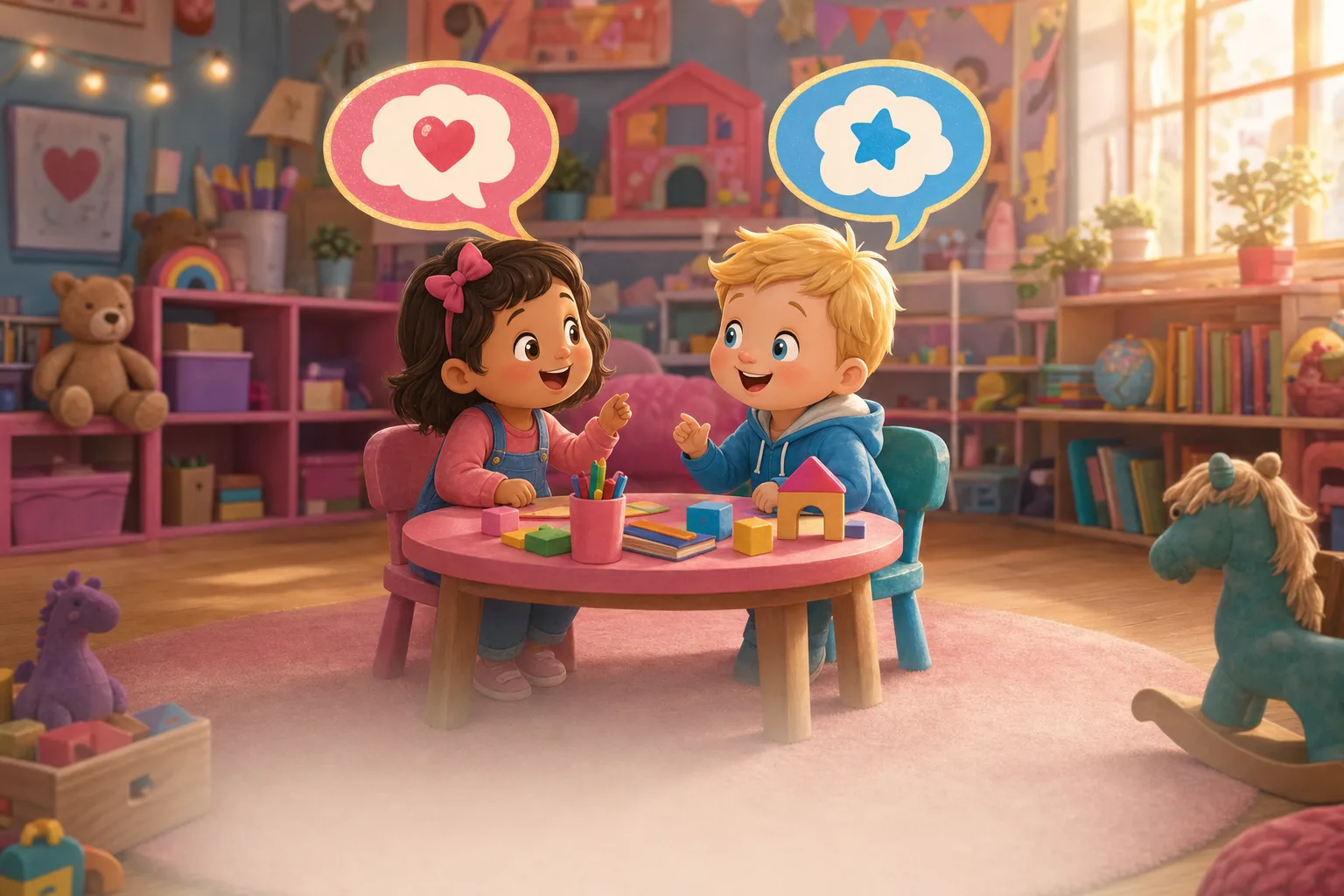
Last updated: 23 July 2026
Your child's two (or three) languages are a gift, not a problem
At Teddy Kids we have looked after bilingual children since 2004. Some hear English at home, some Dutch, some Arabic, Polish, Spanish, Mandarin, Tigrinya — and then Dutch (and often English too) with us. For a lot of our families the picture is trilingual: two languages at home, Dutch at daycare. That is not the exception here. It is half of who we are.
And yet almost every bilingual parent arrives carrying the same quiet fear: am I confusing my child? Am I holding back their Dutch? Should I just switch to one language? The short answer, backed by decades of research, is no — keep going. This guide explains why, without sugar-coating the parts that genuinely take patience.
The four big myths, busted
These are the four we hear most often at pick-up and drop-off. Each one sounds reasonable. Each one has been studied for decades. And each one is, quite simply, not true.
"Two languages will confuse my child"
Myth → FactBabies tell languages apart from the very start — newborns already react to the different rhythms of the languages they heard in the womb. From early on, children build a separate system for each language rather than one jumbled pile. They are not confused; they are sorting, and they are remarkably good at it.
- Newborns distinguish languages by rhythm and melody
- Each language is stored and built as its own system
- Knowing which language to use with whom is itself a skill your child is practising
"Bilingualism causes a language delay"
Myth → FactThis is the big one, and the evidence is clear: bilingual children reach the core milestones — first words, first two-word combinations — within the same normal age range as children with one language. The catch is how you count. If you only count Dutch, a child who splits their words across two or three languages can look 'behind'. Count every language together and the picture is right on track.
- First words and two-word phrases arrive in the same window as for monolingual children
- Total vocabulary across all languages is the measure that counts
- Knowing 30 words in Dutch and 40 in another language is 70 words — a healthy total
- A child may know 'dog' in one language and 'water' in the other; together they are learning both concepts
"Mixing languages means something is wrong"
Myth → FactSlipping two languages into one sentence — 'Mag ik de red one?' — is called code-mixing, and it is one of the most misread things bilingual children do. It is not a sign of confusion or a vocabulary hole. It is normal, rule-governed, and something fluent bilingual adults do all the time on purpose. Often a child mixes simply because one word came faster in the other language — exactly what you would do too.
- Code-mixing follows grammatical rules — it is skilled, not sloppy
- Fluent bilingual adults mix on purpose, all the time
- It usually settles as a child grows and learns who speaks which language
- Responding calmly in the language you want models it — no need to correct or scold
"You have to pick one language"
Myth → FactSometimes a parent is advised to drop the home language and 'just do Dutch' to help a child fit in. This is the advice we most wish we could unwind. Your home language is your child's deepest, warmest, most fluent connection — to you, to grandparents, to a whole family and culture. It does not compete with Dutch; it gives your child a strong foundation that Dutch then grows on top of. Speak the language you dream and comfort in.
- The home language is the foundation Dutch builds on, not a rival to it
- Speak the language you are most fluent and warmest in — your child needs rich input, not perfect grammar
- Dropping the home language can cut a child off from grandparents and heritage
- Trilingual is fine: two home languages plus Dutch is a completely workable, common set-up
The one line to remember
- Add up all your child's languages. That total — not the Dutch column on its own — is the true measure of how they are doing.
What growing up with two or three languages actually looks like
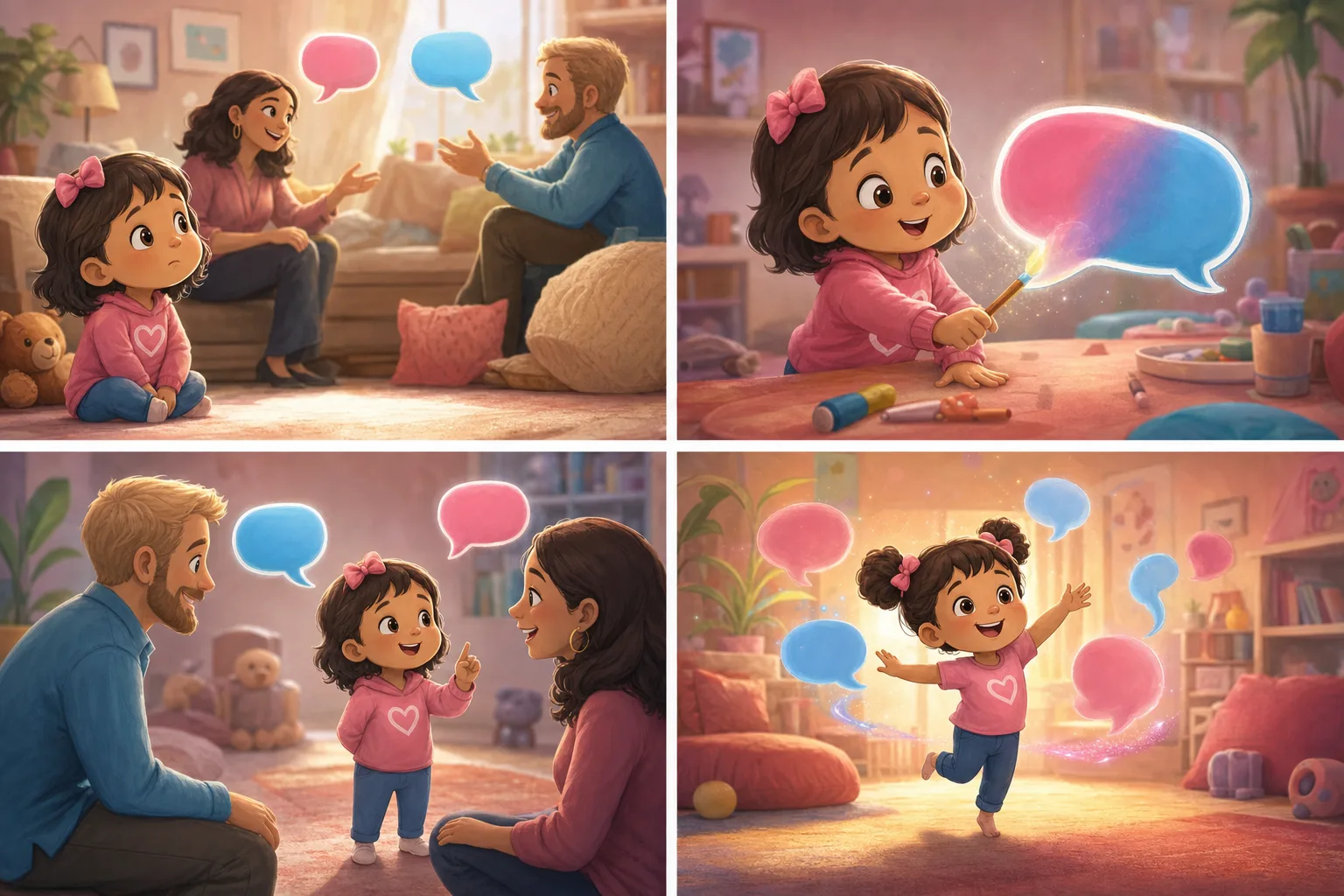
Bilingual development is not slower — it is shaped differently, and a few of its normal stages are the very ones that scare parents. Knowing them in advance turns 'something is wrong' into 'ah, this is the bit the guide mentioned'.
The silent period
Often when starting a new languageWhen a child meets a new language — for many of our children, Dutch on their first days with us — they may go quiet for weeks or even months, listening hard before they speak. This silence is busy work, not a delay. They are gathering the language before they risk using it, and we give them all the room they need.
One word here, another there
The vocabulary splitYoung bilinguals often learn a word in whichever language they first met the thing. 'Slide' at daycare, the food words at home. So each language has gaps the other fills. This is why counting one language alone always undersells them — and why the gaps close as the words cross over with time.
Learning who speaks what
The sorting stageSomewhere in the toddler years children work out that Papa gets one language, the juf gets another, and Grandma gets a third. You will see them switch the moment they turn to a different person. When that clicks, the mixing usually eases on its own.
Trilingual is its own rhythm
Two home languages + DutchFor families with two home languages plus Dutch, everything above still holds — there is simply more to sort, so some children take a little longer to get talkative in each. That is a spread of the same normal, not a problem multiplied. Rich, regular time in each language is what keeps all three alive.
Ways families organise their languages
There are a few well-known 'systems' for raising a bilingual child. Here is the honest part: no single one is proven to beat the others. What the research keeps landing on is consistency and plenty of warm, real input in each language. Pick the pattern that fits your family's actual life — and trilingual families happily mix and match.
One parent, one language (OPOL)
Each parent, their languageEach parent speaks their own language to the child, consistently. Classic, easy to explain, and gives each language a clear 'owner'. It does not need to be rigid — the point is a dependable pattern, not a rule you punish yourself over.
- Clear and easy for a young child to follow
- Each language gets guaranteed daily time
- Works well when parents have different first languages
Minority language at home (mL@H)
Home language everywhere at homeThe whole family uses the home language indoors, and Dutch comes from daycare, school and the world outside. Because Dutch is everywhere anyway, giving the home language the whole house helps it keep up. A favourite for families whose home language would otherwise be drowned out.
- Protects a home language that the wider world does not reinforce
- Simple: one language for home, Dutch for outside
- The environment supplies Dutch, so you can focus on the home language
Time and place
Language tied to a momentLanguage follows a routine rather than a person: one language at dinner, another at bedtime; weekdays and weekends; this room and that one. Flexible and forgiving — good for families where both parents share both languages.
- Bends around real family life instead of fighting it
- Easy to add a third language into a slot of its own
- Routines do the remembering for you
One context, one language
Home language + Dutch at daycareThe most common set-up among our families, and often the least planned: the home language(s) live at home, and Dutch (plus English, with us) belongs to daycare. Your child learns each language where it naturally lives. You barely have to engineer it — you mostly have to trust it.
- Barely any planning — each place already has its language
- Daycare carries the Dutch, so home stays home
- Scales naturally to trilingual: two languages at home, Dutch here
What actually matters most
- Consistency beats method — a pattern your child can rely on matters more than which system it is
- Quantity and warmth of talk in each language matter more than grammatical perfection
- You are allowed to change your approach as life changes — a new sibling, a move, a new job
- Trilingual families can blend two or three of these — there is no purity test
What we see at Teddy Kids
Twenty years of bilingual groups gives you a certain calm about all of this. Here is what actually happens on our floors — and how language runs through a normal Teddy Kids day.
How language runs in our groups
- Children hear both Dutch and English across the day, woven into play, songs and routines rather than taught in lessons
- Our caregivers speak naturally and consistently, so each child knows which language belongs to which moment and person
- Songs, books and mealtime words are where a lot of the new language quietly lands
- New children are given room for their silent period — we never push a child to speak before they are ready
Patterns we love to watch
- A child who barely spoke Dutch for months, then one week arrives chatting in full sentences — the silent period paying off all at once
- Toddlers who firmly 'assign' a language to each caregiver and switch the instant they turn to a different one
- Little ones translating for a newer friend who shares their home language — proud, capable, completely natural
The families we serve
- Many home languages come through our doors — and for a large share of our families, home itself is already bilingual
- Trilingual children — two languages at home, Dutch (and English) with us — are completely ordinary here, not a special case
- Because bilingual life is our everyday, worried parents are usually reassured simply by seeing how normal their child's path looks alongside the others
None of this is a promise about your individual child — every child has their own tempo. It is simply what two decades of bilingual daycare have shown us, again and again.
When to check in with someone — and who
Everything in this guide is about calming needless worry — but trusting your instinct still matters. Bilingualism does not cause language disorders, and it never hides one either: a genuine difficulty shows up across all of a child's languages, not just in Dutch. If something feels off, you do not diagnose it at home and you do not wait it out alone. You ask the people whose job this is. Below is where to go, not a checklist to score your child against.
Where to turn
- The consultatiebureau (JGZ) — your free first stop; they follow your child's development and can look at all languages together
- A logopedist (speech-language therapist) — the specialist for language questions, ideally one experienced with multilingual children
- Your huisarts — who can refer you on if that turns out to be the right step
- Your child's Teddy Kids mentor — we see your child every day and are glad to share what we notice and, if it helps, point you toward the consultatiebureau
Two things worth knowing
- A real language difficulty shows in every language a child speaks — so tell the professional about all of them, and bring someone who knows the home language if you can
- Being bilingual is never a reason to 'wait and see' longer than you would for any other child — trust your gut and just ask; asking early costs nothing
Frequently asked questions
My child mixes both languages in one sentence. Should I correct them?
No need to correct or scold. Mixing (code-mixing) is a normal, skilful stage. The gentle move is simply to answer back in the language you want to encourage — modelling it rather than marking it wrong. It settles as your child learns who speaks which language.
My partner and I speak different languages. Which should we each use?
Each speak the language you are most fluent and comfortable in — the one you can be rich, silly and warm in. Your child needs a lot of real, expressive language far more than they need any particular split. One-parent-one-language is the classic route, but any consistent pattern works.
Will learning Dutch at daycare slow down their home language?
Languages are not a zero-sum jar — filling one does not empty another. What keeps a home language strong is time and warmth in it. Daycare adds Dutch on top; your evenings, weekends, books and video calls with family keep the home language thriving.
We speak two languages at home and Dutch is the third. Is trilingual too much?
It is not too much — it is common, and children manage it all over the world. There is simply more to sort, so some trilingual children take a little longer to become chatty in each language. Give each language regular, real time and all three can flourish.
My child was chatty, then went quiet after starting daycare. Is that normal?
Very often, yes — it is the silent period. Meeting a new language, your child may listen intently for weeks before speaking it, while still talking happily in their home language. If they also go quiet in the home language, or you are worried for any reason, check in with the consultatiebureau.
Should we switch to only Dutch to help our child fit in?
Please don't drop your home language for this. Speaking to your child in a language you are not fully at home in gives them thinner, less warm input — and cuts them off from family and heritage. Keep your home language rich; Dutch will come from daycare, friends and school.
Is one of my child's languages allowed to be stronger than the other?
Absolutely — almost every bilingual person has a stronger and a weaker language, and which one is stronger can shift over the years with school, friends and moves. An uneven balance is the norm, not a fault to fix.
Where to read and ask more
Reputable, non-commercial places for bilingual and multilingual family questions.
- Consultatiebureau / Centrum voor Jeugd en Gezin (JGZ) — free child-development support
- NVLF — find a speech-language therapist (logopedist) in the Netherlands
- Meertalig.nl — Dutch platform on raising children with more than one language
- Nederlands Jeugdinstituut (NJi) — evidence-based information on child development
- Bilingualism Matters (University of Edinburgh) — research-based advice for multilingual families
- Your child's Teddy Kids mentor — always happy to talk about how your child is doing
About this guide
This guide is for educational purposes and reflects the current consensus in research on bilingual and multilingual language development, together with what we observe at Teddy Kids. It is not a diagnostic tool and does not replace personal advice. If you have any concern about your child's development, speak with your consultatiebureau (JGZ), a logopedist or your huisarts — a real difficulty shows across all of a child's languages, and being bilingual is never a reason to wait longer before asking.
Teddy Kids is here for you
As your twins grow, we grow with you — with warm, bilingual childcare in Leiden.