Building Your Village: Raising Kids Far From Family
You were never meant to do this alone — and the good news is a village can be built on purpose, one bench, one drop-off, one honest ask at a time.
"It takes a village" is not a slogan — it's a description of how humans have always raised children. If you're parenting in the Netherlands without grandparents down the road, the village didn't disappear because you failed at something. It's simply not there yet. This guide is about building one from scratch: where villages actually form here, how to read Dutch friendship, and how to ask for help without feeling like a burden.
Start building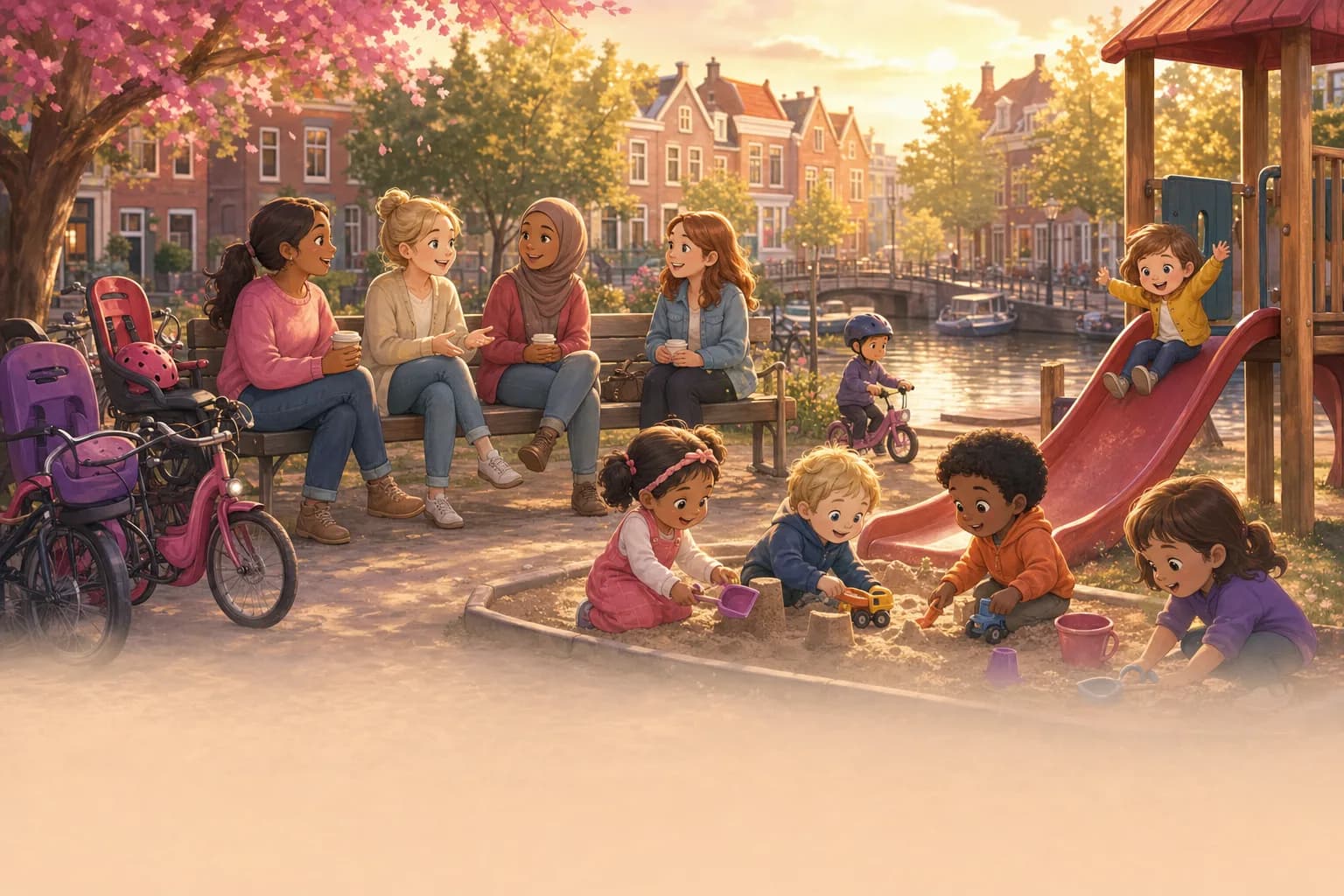
Last updated: 24 July 2026
The village gap is structural, not personal
For most of human history, children were raised by a web of people: parents, yes, but also grandparents, aunts, older cousins, neighbours who'd known you your whole life. The nuclear family alone in a flat, doing everything, is a very recent and very unusual arrangement — and when you add a move to a new country, even that thin web can be missing entirely.
So if you feel stretched, touched-out, and quietly astonished at how hard this is, read this first: nothing has gone wrong with you. You are trying to do the work of six people with two, or with one. The exhaustion is the predictable result of a missing structure, not a character flaw or a sign you're a worse parent than the ones who look serene at the school gate.
The village hasn't vanished — it just has to be built on purpose now, rather than inherited. That's genuinely harder, and it's also genuinely doable. The chapters below are the how: where connections form in the Netherlands, how to read the Dutch version of warmth, and how to make the ask that turns a friendly face into actual backup.
Mapping your village: the four layers
A village isn't one big group of best friends — that's a myth that makes the whole thing feel impossible. It's layers, each doing a different job. You don't need many people in any single layer; you need a few in each. Naming the layers turns a vague ache ("I have no one") into a to-do list ("I have an inner circle and professionals, but no swap-parents yet").

Inner circle
The 2 a.m. peopleThe one or two people you'd call in a real crisis — a partner, a sibling on video call, one close friend. They may be far away, and a voice on the phone still counts. This layer is often the fullest for newcomers, because it moved with you. The work here is keeping it warm across distance, and not asking it to carry everything.
Swap-parents
The practical backupOther local parents you trade favours with: an emergency pickup, a sick-day handover, a Saturday where you take all four kids so they can take yours next week. This is the layer newcomers most often lack, and the one this guide is really about — because it can't be inherited, only built, usually out of parents you meet through your child.
Professional layer
Paid, trained, reliableDaycare, your consultatiebureau nurse, a huisarts, a trusted babysitter, a gastouder. Paid and trained doesn't mean cold — this layer is often the most dependable of all, and for a newcomer family it's frequently the first solid ground. Daycare in particular is quietly village infrastructure: it puts you in a room, five days a week, with other parents whose children are exactly your child's age.
Community layer
The wide, loose netThe looser web: your street's buurtapp, a sports club, a place of worship, an expat-parent group, the regulars on the same playground bench. No single person here is close, but together they make a place feel like yours — and swap-parents and even inner-circle friends are very often people who started out in this outer ring.
A five-minute exercise
- Write the four layers down and put real names under each — even if some are empty
- The emptiest layer is your project this season; you don't need to fill all four at once
- Most newcomers are full in the inner circle, thin on swap-parents — that's the normal shape
Where villages actually form in the Netherlands
Friendships between parents almost never start with "let's be friends." They start with repeated, low-stakes proximity — the same faces, the same time, the same place, week after week, until a nod becomes a chat and a chat becomes a coffee. So the trick isn't to be more outgoing; it's to put yourself somewhere with built-in repetition. Here are the places in the Leiden region where that repetition already exists.
The daycare drop-off
Pre-vetted, same-age kidsThe other parents at your child's group are a gift most newcomers overlook: they live nearby, they have a child your child's exact age, and they're already inside the same trusted place you are. The small-talk at the door — "how did she sleep?", "which school are you thinking about?" — is the first rung of a ladder that climbs to playdate, then to backup-parent.
- Arrive two minutes earlier than you need to — small talk lives in the spare minutes
- Learn one other child's name and use it; parents warm fast to anyone who knows their kid
- After a few weeks, try: "Shall we let them play together one Saturday?"
Consultatiebureau & baby groups
Same life stage, same weekThe consultatiebureau (via the CJG / GGD) runs weigh-ins and often parent groups; babyswimming and mother-and-baby classes gather people whose babies were born within weeks of yours. Nobody there has it more figured out than you — that shared cluelessness is exactly what makes the connection easy.
Speeltuin & speeltuinvereniging
The bench is the networkA neighbourhood speeltuin — and especially a membership speeltuinvereniging with a fenced garden and regulars — is a village engine. Go at the same time on the same days and you'll start recognising faces within a fortnight. The bench beside the sandpit is where more Leiden parent-friendships begin than anywhere else.
Library voorleesuurtje
Free, warm, indoorsThe library's free story hour (voorleesuurtje) is a low-pressure, repeating, indoor fixture — perfect for rainy Dutch months and for shy parents. You sit in a circle, the children do the mingling for you, and the same families tend to come back each week. BplusC in Leiden runs these across its branches.
Sports, zwemles & club benches
The waiting parentsOnce children start zwemles, gym, football or ballet, a new bench appears: the parents who wait through every lesson, every week, for years. Waiting is boring, and boredom is social glue. The parent beside you on the swimming-pool bench is a friendship on a very slow, very reliable timer.
Buurtapps & expat-parent groups
Online door to offlineA street WhatsApp group, Nextdoor, a local buurtapp, or a Leiden expat-parents Facebook group turns strangers into neighbours you can actually ask. Use them for the practical (a borrowed stair gate, a recommended huisarts) and let the offline coffees follow. Church and community-centre (buurthuis) groups do the same job for many families.
The one rule that ties them together
- Pick two places and go regularly, rather than ten places once — repetition beats variety every time.
- Give it six to eight weeks before you judge whether a place is "working"; village-building runs slower than you'd like.
The Dutch friendship decoder
Many newcomers conclude the Dutch are cold or uninterested, then quietly give up — when in fact the warmth was there, just wearing unfamiliar clothes. Dutch social life runs on the agenda (the planner) and on directness. Once you can read those two things, a lot of "rejection" turns out to have been an invitation you didn't recognise. Here's the decoder.
What it looks like (and worries you)
- "Sounds nice, let me check my agenda" — and then a date three weeks away
- No spontaneous drop-ins; everything is planned, even coffee with a close friend
- Blunt, direct feedback with no cushioning — "no, that doesn't suit me"
- Warmth that doesn't escalate fast; weeks of friendliness before any invitation home
- Small talk stays genuinely small — weather, kids, bikes — for a long time
What it actually means
- A planned date three weeks out is a real yes — planning it IS the warmth, not a stall
- The agenda is respect for everyone's time, not distance; put the date in and it will happen
- Directness is honesty you can trust — a Dutch "yes" means yes, and "no" spares you guessing
- Slow-to-escalate friendships tend to be the durable ones; once you're in, you're in for years
- Repeated small talk is the relationship building its foundation; depth comes after the base is laid
Practical upshot: don't wait for a spontaneous invitation that isn't coming — propose the concrete plan yourself. "Zullen we volgende week woensdag koffie doen?" ("Shall we get coffee next Wednesday?") is exactly how it's done here, and naming a day makes you refreshingly easy to say yes to.
The ask-for-help rehearsal
The single move that turns a friendly acquaintance into an actual swap-parent is the ask — and it's the move most of us dread. We're afraid of imposing, so we wait until we're desperate, then ask in a panic, wrapped in apology. But a good ask is small, specific, and framed as a two-way street. Here's how to rehearse it so the words are ready before the sick day hits.
Start with a tiny, low-stakes ask
Warm up the muscle
Don't open with "can you have my child overnight?" Open with something so small it's easy to say yes to: "Could you watch her for two minutes while I grab the bikes?" Small asks build the trust — and the track record — that big asks later rest on.
Be specific, not vague
Easy to say yes to
"Let me know if you ever need anything" goes nowhere. A specific, time-boxed ask is a gift of clarity: "Could you pick Sara up at 15:00 on Thursday and keep her till 17:00?" The other parent knows exactly what they're agreeing to, which makes yes far easier than an open-ended favour would.
Lead with reciprocity, not apology
Reciprocity beats sorry
Skip "I'm so sorry to bother you, I feel terrible asking." Apology makes the other person carry your discomfort. Offer the trade instead: "Could you take mine Thursday? I'll take yours Saturday so you two get an evening." Reciprocity turns a favour into a partnership, and partnerships don't keep score anxiously.
Say yes when they ask you
Be an easy village too
The fastest way to earn a village is to be one. When another parent asks you for a pickup or a playdate, say yes warmly and often — even when it's mildly inconvenient. Every yes you give makes your next ask easier, and signals that this is a relationship where both of you can lean.
- Small, specific asks are far easier to grant than big, vague ones
- Reciprocity removes the sense of debt — it's a swap, not a rescue
- Every favour you give makes your next ask land more easily
- Rehearsing the words now means you won't freeze on the day you need them
Your emergency card — and a word on loneliness
Here's a small exercise that quietly tells you how your village is doing: the three-calls test. If your child were sick and you had to be somewhere in an hour, who are the three people you could call? Newcomers often reach three and stop cold — and that blank is not a verdict on you, it's simply the next thing to build. Write the list; the gaps are your to-do, and the names you already have are proof you've started.
Build your three-calls list
- Name three people who could take your child on short notice — a swap-parent, a neighbour, a babysitter
- Ask each one directly: "Can I put you on my emergency list, and you put me on yours?"
- Keep the numbers where a partner or babysitter can find them, and give your child's group the same names
- If you can't reach three yet, that's your project — one new name this season is real progress
When it's heavier than tiredness
- Parental loneliness is common and well-documented — feeling isolated does not mean you're doing badly
- Distinguish a hard week from a heavy fog: persistent low mood, dread, or numbness that doesn't lift is worth taking seriously
- Your huisarts is the front door; ask for the POH-GGZ (the practice's mental-health support) — it's normal, confidential and often free
- In your own language if that's easier — many Leiden practices can help you find support that fits
Questions newcomer parents ask
The worries below come up again and again when families raise children far from home. Short, honest answers — because you have enough to carry.
I don't speak Dutch yet — can I still build a village here?
Yes. In the Leiden region many parents speak good English, and expat-parent groups exist precisely for this. Start where language is lowest-stakes — the playground, the daycare door, a story hour where the children lead — and let a few words of Dutch ("gezellig", "zullen we?") signal you're trying. Learning the language will widen your village over time, but it is not the entry ticket. Warmth and reliability cross languages faster than grammar does.
I'm an introvert — this all sounds exhausting.
Then build an introvert's village: small and deep, not big and loud. You do not need a crowd — two or three reliable swap-parents is a functioning village. Lean on repetition rather than charisma; the same bench, the same story hour, the same faces do the social work so you don't have to perform. One steady coffee a fortnight beats a party you dread.
Isn't it a burden to keep asking other parents for help?
Only if it flows one way. A reciprocal ask isn't a burden — it's the beginning of a friendship most parents are quietly hoping for too. Remember that the other family very likely also lacks nearby grandparents; when you offer to take their child so they get an evening, you're not taking, you're building something you'll both draw on. The parents who never ask often end up the most alone.
We might move again in a year or two — is it worth investing?
Yes — arguably more, not less. You need support now, during the hard years of small children, whether or not you stay. A village built for eighteen months is still eighteen months of backup, shared Saturdays and someone who notices when you're struggling. And connections made through children have a way of outlasting the postcode; plenty become the video-call inner circle of your next chapter.
My child is shy too — how do I help them find friends?
The same repetition that builds your village builds theirs. Regular, familiar settings — their daycare group, a weekly club, the same playground — let a shy child warm up at their own pace, without the pressure of constant new faces. One or two steady playmates matter far more than popularity. And when you befriend another parent, you often hand your children a ready-made friendship as a bonus.
Places to start building
A few real, local doors into the village. None asks much of you — just showing up, more than once.
- BplusC (Leiden library) — free voorleesuurtje story hours and family activities across its branches
- Consultatiebureau (Centrum voor Jeugd en Gezin) — weigh-ins, parent groups and free advice on your child
- Expat Centre Leiden — practical help and events for internationals settling in the Leiden region
- ACCESS NL — English-language guidance and community for internationals, including parenting and wellbeing
- Opvoeden.nl — trusted Dutch parenting information, including on building support around your family
Teddy Kids is here for you
As your twins grow, we grow with you — with warm, bilingual childcare in Leiden.