Living With Water: Canal & Swim Safety for Leiden Families
Leiden is built around water — and that is a gift. Here is how international families with little ones turn canals from a worry into a joy, one confident step at a time.
In the Netherlands, swimming is not a hobby — it is a life skill, taught as carefully as crossing the road. If you have just moved to Leiden with a toddler, the canals outside your door can feel daunting. They needn't. With a little Dutch know-how, the right habits now, and swim lessons booked early, water becomes one of the best parts of growing up here.
Start reading
Last updated: 24 July 2026
Why this guide exists — for families new to Dutch water
Leiden is a canal city. Water runs alongside streets, gardens and playgrounds, and for children who grow up here it becomes as ordinary and joyful as a park. That everyday closeness to water is exactly why the Netherlands treats swimming as a basic safety skill rather than a sport — and why a little preparation matters most in the very first years.
This guide is written especially for international and newcomer families. There is a simple, non-judgemental reason for that focus: Dutch public-health data shows that children who did not grow up around Dutch water culture — who haven't yet done the local swim lessons every Dutch child does — are statistically at higher risk near water until those lessons are complete. Children under ten who were born outside Europe carry a drowning risk more than eight times higher than their Dutch-heritage peers; for children born here to parents from outside Europe, it is around four times higher.
Read sensitively, that number is not about background — it is about swim exposure and water familiarity, and both are entirely fixable. A family that arrives, builds good water habits, and books swim lessons early moves out of that higher-risk group. That is the whole purpose of this guide: to hand you the Dutch know-how that local families absorb over a lifetime, in one calm read.
Why the Dutch treat swimming as a survival skill
To understand Dutch swim culture, start with the map. Roughly 18% of the Netherlands is water — polders, canals, rivers and lakes — and daily life happens right beside it. Open water isn't something you visit at a beach; it's at the end of the street. So swimming here is treated less like a leisure sport and more like basic personal safety, the way some countries treat road-crossing. The result is striking: about 97% of Dutch teenagers hold a swim diploma.
A country shaped by water
HistoryThe "fight against water" runs through Dutch history and identity. Organised swimming spots appeared as far back as the early 1800s, often just a jetty with a railing along a canal bank, to bring some structure to open-water swimming. Over the 20th century, drowning deaths fell sharply — especially among children — as swim education became near-universal. Learning to swim is, quite literally, part of how this country keeps its people safe.
Where the risk really sits
The statisticsIn 2025, 100 people died from accidental drowning in the Netherlands (down from 113 in 2024; the five-year average is about 93 a year). Most happen not at sea or in pools but in the everyday water all around us: ditches, rivers, canals and waterways account for 53.7% of drownings. For a canal city like Leiden, that is the number that matters — and the reason canal-side habits, below, are worth building early.
The youngest need the most watching
Ages 0–4Among children, the 0–4 age group faces the greatest drowning and near-drowning risk of all — with 4–12 year-olds second. One in five drowning victims treated in the emergency room is a one- or two-year-old. This isn't a reason for fear; it's a reason for the simple supervision habits later in this guide, in the window before your child is old enough for formal swim lessons.
The Zwem-ABC, decoded
Dutch swimming diplomas run on one national system, the Zwem-ABC, overseen by the Nationale Raad Zwemveiligheid (NRZ). It is three diplomas earned in order — A, then B, then C — each adding harder, more realistic skills. Crucially, the system builds in swimming with your clothes on, because real accidents happen when you're dressed. A child who finishes all three is called "zwemveilig" — swim-safe — and has met the Nationale Norm Zwemveiligheid, the national swim-safety standard. Here is what each stage means.
Diploma A
The foundationThe starting diploma: basic swimming skills in a calm pool, without slides or attractions. Children commonly begin around 4.5–5 years old, and reaching diploma A typically takes roughly 12–18 months of weekly lessons. This is where a child learns to move through water with confidence and control.
- Basic strokes and breathing in a calm, shallow pool
- Confidence going underwater and surfacing safely
- The groundwork every later skill is built on
Diploma B
Real-world waterThe second diploma sharpens technique and endurance, and introduces water as it really is: pools with attractions and slides, and — for the first time — swimming in clothes. That clothed swimming is the heart of the Dutch approach: because if a child ever falls into a canal, they'll be fully dressed. B teaches the body to cope with the drag and surprise of that.
- Stronger technique and longer endurance
- First experience swimming fully clothed
- Comfort in busier water with slides and attractions
Diploma C
Swim-safe: the national standardThe highest of the three, and the one that certifies the national swim-safety standard. Children typically reach it around ages 6–8, a few months after B. The exam is deliberately realistic: swimming 50+ metres fully clothed, orienting underwater, navigating open water, and holding the HELP position (Heat Escape Lessening Position) — a curled posture that slows heat loss in cold water. Passing C means a child can genuinely manage themselves in and around water.
- 50+ metres swum fully clothed, plus underwater orientation
- The HELP position for surviving cold-water immersion
- Officially "zwemveilig" — the national swim-safety standard met
Good to know
- Clothed and survival-style swimming isn't a separate niche course here — it's built right into the mainstream A–B–C path, from diploma B onward.
- Progress is usually individual, not by group: a child moves up when they're ready, not on a fixed timetable, so don't compare your child to the calendar.
Swim lessons in Leiden — and why to sign up early
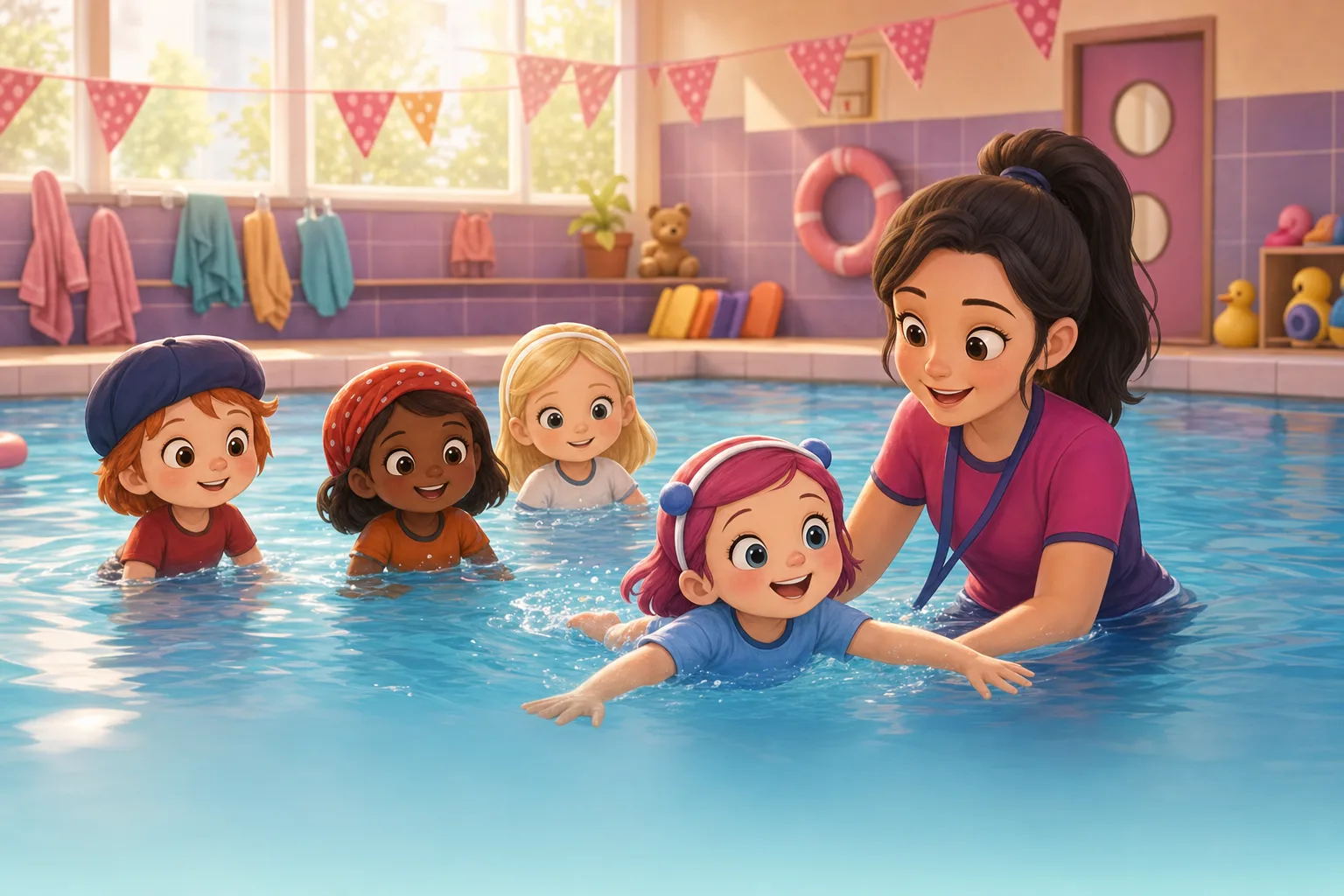
Leiden has two municipal pools offering Zwem-ABC lessons, both run via Sport in Leiden: Zwembad De Zijl in the north, and Binnenbad De Vliet in the south-west. Lessons are delivered by certified swim schools such as ZVL-1886 and Zwemschool Leiden. The single most useful thing to know as a newcomer: there is almost always a waitlist, so the real skill is registering early. Here is how to approach it.
Register early — think age 3, not age 4
Do this first
Lessons themselves usually start around age 4 to 4.5, but registration often opens earlier — one Leiden provider takes registrations from age 3 and places children on a waiting list. Because waits are real, the winning move is to put your child's name down well before they're ready to start swimming. Treat it like a to-do for your child's third birthday.
Expect a waitlist — and don't let it stop you
Set expectations
Waitlists for Dutch swim lessons are widely reported and can vary a lot by pool, day and time. Rather than chase an exact number that changes constantly, plan for a wait and register ahead of it. It's also worth asking each provider directly: availability differs between locations and time slots, and a less popular day may move faster.
Pick a pool and a provider
De Zijl or De Vliet
De Zijl and De Vliet are both good starting points; which suits you often comes down to travel and available times. Lessons are the standard 45 minutes and typically run Monday to Saturday. Group sizes are small (commonly around 8–10 children), and many providers let your child progress individually rather than as a fixed class — so a keen swimmer isn't held back and a cautious one isn't rushed.
Budget for it, and check for support
Costs
Weekly lessons cost money over the months it takes to reach a diploma, and municipal pools tend to be somewhat cheaper than private swim schools for a comparable lesson. Exact prices change year to year, so confirm current tariffs directly with Sport in Leiden or your chosen swim school before you commit. If cost is a barrier, ask the gemeente about support schemes — the Netherlands has funds that help families cover swim lessons.
- Two municipal pools: De Zijl (north) and De Vliet (south-west)
- Certified providers under the national Zwem-ABC standard
- Small groups, individual progression, 45-minute lessons
- Register around age 3 to get ahead of the waitlist
Before formal lessons: keeping ages 0–4 safe
There is a gap between the age a child starts walking and the age swim lessons usually begin — roughly ages one to four. That gap is exactly the window in which most young-child water accidents happen, which is why your habits during these years do the heavy lifting. None of this needs to be tense or fearful; it's just a handful of small routines that quickly become second nature, and plenty of joyful water time along the way.
Everyday canal-side habits
- Within arm's reach: for children 0–4, close, active supervision near any open water is the single most important safety layer — a toddler can slip in silently in seconds.
- Walk on the house side: on canal-side paths, keep your child on the side away from the water, holding a hand or in the pram, especially where there's no railing.
- Mind the small water too: garden ponds, canal-adjacent gardens, paddling pools, water butts and even bathtubs count — empty or cover them, and never leave a young child alone beside them.
- Bikes and buggies near quays: when you stop by a canal, engage the pram brake and keep a hand on wriggly toddlers — many Leiden streets end right at the water with no barrier.
Warm ways to build water confidence
- Babyzwemmen (parent-and-baby swimming) is widely available from a young age — often from around nine months — as a playful way to get little ones comfortable in water. It's not a diploma course and doesn't replace Zwem-ABC, but it builds a lovely head start.
- Make bath time water-friendly: pouring, floating, gentle face-splashing and blowing bubbles all quietly prepare a child for lessons.
- Talk about water calmly and positively — "we always hold hands by the canal" — so respect grows without fear.
- You may hear about intensive infant "survival swimming" methods. These are debated in the Netherlands and are not part of the official Zwem-ABC pathway; if you're curious, discuss it with a trusted professional rather than assuming it's endorsed.
If a child falls into the water
Knowing the steps in advance is what lets you act fast and stay calm — panic costs seconds, and seconds matter. This is general first-aid guidance, not a substitute for a first-aid course; if you can, take an infant-and-child first-aid class (EHBO), which is widely available in Leiden. In any real emergency, the first and most important thing is always the same: call 112.
Shout for help and call 112
Immediately
Call out so others come to help, and call 112 — or have someone else call while you act. 112 is the free Dutch emergency number for ambulance, police and fire, and the operator can guide you. Don't wait to see if things improve; make the call straight away.
Get the child out safely
Without endangering yourself
Reach the child out of the water as quickly as you safely can. Try to reach or pass something first — a hand from solid ground, a branch, a bag strap — rather than jumping into a cold canal yourself if it can be avoided, because a second person in trouble helps no one. Once out, get them onto their back on firm ground.
Check breathing; start CPR if needed
The critical check
Speak to the child and gently shake their shoulders to check for a response, open the airway, and look for normal breathing. If the child is unconscious and not breathing normally, start CPR immediately and keep going until help arrives — the 112 operator will talk you through it. This is exactly the skill a child first-aid course gives you the confidence to do.
See a doctor — even if they seem fine
Afterwards, always
Any child who has inhaled water must be seen by a doctor, even if they seem recovered — contact your huisarts or the huisartsenpost. Water in the lungs can cause problems that appear later, and warning signs (breathing changes, unusual tiredness or a change in behaviour) can develop for up to 48 hours. Keep the child warm and dry in the meantime, as even a short dunk brings a risk of getting cold.
- 112 is the free Dutch emergency number — call it first
- Reach or throw before you jump; don't become a second victim
- Unconscious and not breathing normally → start CPR at once
- Always see a doctor after any near-drowning, even if the child seems fine
When the canals freeze: winter ice safety
In a hard-freeze winter, Dutch canals become something magical: natuurijs, natural ice, and the whole country goes skating — children very much included. It's one of the great joys of living here. But natural ice is unpredictable in a way a rink never is, so it comes with a short list of firm rules. The golden one for families: a child never skates on natural ice alone.
The golden rules for children
- Never let a child skate alone: a "skate buddy" is considered essential — always go in at least pairs, ideally small groups.
- Ice should be at least 5 cm thick before it's considered safe to skate on — and thickness is never uniform across a canal.
- Tell someone at home where you're going, and wear head protection; a helmet is recommended for children.
- Talk it through together: explore what is and isn't safe on the ice with your child, rather than only issuing instructions.
How to know the ice is really safe
- Wait for a sustained freeze, and don't judge by eye alone — thin patches and moving water under bridges stay dangerous even when the rest looks solid.
- Check with the local ijsclub (skating club, often KNSB-affiliated) or a national source like schaatsen.nl to see whether the ice has actually been released for use.
- Organised toertochten — tour-skating events run by skating clubs once a freeze is well established — are the benchmark for the safest skating.
- With very young children (0–4), enjoy the atmosphere from firm ground or the very edge; genuine skating comes later, once they're steadier and can follow the buddy rule.
Useful links
A short, reliable set of starting points — from the pools where lessons happen to the national bodies behind the numbers and the diploma system.
- Sport in Leiden — Zwemmen: the two municipal pools (De Zijl, De Vliet) and lesson information
- ZVL-1886 — Leszwemmen: a certified Leiden swim school running Zwem-ABC lessons
- Nationale Raad Zwemveiligheid (NRZ) — the Zwem-ABC and national swim diplomas explained
- VeiligheidNL — Verdrinking: national prevention advice on drowning and young children
- Schaatsen.nl — golden rules for safe skating on natural ice (natuurijs)
About this guide
This guide is for general information and reflects Teddy Kids' warm, everyday care in a city built around water. It is not emergency, medical or first-aid instruction: in any emergency, call 112 immediately, and for first aid take a certified child first-aid (EHBO) course. Details such as swim-lesson ages, waitlists, prices and pool schedules change over time — always confirm the current facts with the official sources (Sport in Leiden, your swim school, the NRZ), whose information prevails over anything written here.
Teddy Kids is here for you
As your twins grow, we grow with you — with warm, bilingual childcare in Leiden.