The Sleep Map 0–4
One calm map of how sleep really changes in the first four years — instead of ten panicked midnight searches.
Baby and toddler sleep changes constantly between birth and age four. That's not you failing, and it's not your child breaking — it's development doing exactly what it should. This guide gives you the honest version: what's genuinely wired into your child's brain, what the internet oversells, and what tends to help.
Start reading
Last updated: 23 July 2026
Sleep is supposed to keep changing
In the first four years, your child's sleep is a moving target — and it's meant to be. A newborn who sleeps in short, round-the-clock bursts, a six-month-old juggling two or three naps, a toddler dropping to one nap, a three-year-old testing bedtime: these aren't setbacks, they're stages. Every rough patch usually sits right next to a leap in your child's brain or body.
This guide is deliberately calm and deliberately honest. Some of what you'll read online about "sleep regressions" is well-grounded science; a lot of it is marketing dressed up as a fixed calendar. We'll tell you which is which, so you can stop measuring your child against a timetable that was never really real.
Dads, partners, co-parents — this is written for all of you. Night wakings and bedtime standoffs don't check who's on duty.
The 4-month shift: the one real turning point
If there's a single sleep change that's genuinely wired into your baby's biology, it's this one. Somewhere between about 3 and 5 months, your baby's sleep reorganises from newborn-style sleep into a more grown-up structure — and unlike the other famous "regressions," this one has solid physiological grounding.
What actually changes
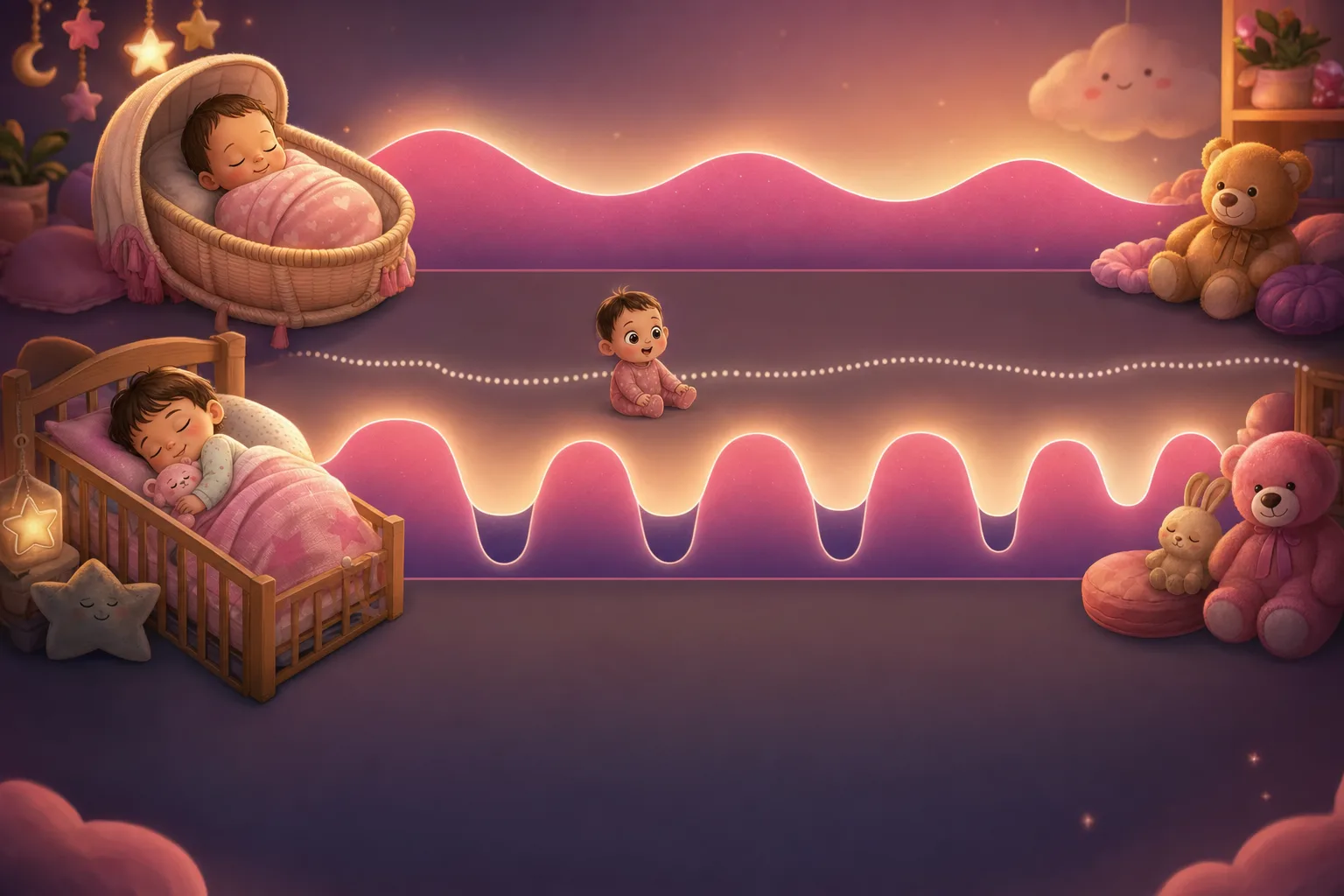
~3–5 months · well-evidencedNewborn sleep runs in simple ~50–60 minute active/quiet cycles with no real day–night rhythm. Around 3–5 months, sleep matures into multi-stage NREM/REM cycles that begin to resemble adult sleep, with cycle length settling toward ~45 minutes. This maps onto documented brain maturation — which is why it's the best-evidenced of all the "regression" ages.
Why it feels like everything broke
In the new pattern, your baby briefly surfaces into light sleep between cycles — roughly every 45 minutes. A baby who used to link cycles automatically now half-wakes and notices: Where am I? Where's the person who rocked me to sleep? Sleep that was seamless suddenly has seams. Nothing is wrong; the machinery just got more sophisticated.
How long it lasts
Weeks, and variableBecause this is a permanent change in how sleep is built, the goal isn't to "get back" to newborn sleep — it's to help your baby learn to bridge those light-sleep moments. That takes weeks, not nights, and the timeline varies from baby to baby. Even this well-grounded shift isn't perfectly universal or clock-precise.
Gentle things that tend to help
- Keep wind-down predictable — the same short ritual, same order, every sleep
- Give your baby a chance to resettle for a moment before you intervene
- Let daytime be bright and lively, nights dim and boring — it feeds the emerging day–night rhythm
- Watch for tiredness cues rather than forcing an exact clock time
- Lower your own expectations for a few weeks — this is a rebuild, not a relapse
Why the internet's regression calendar doesn't match your baby
Search "sleep regression" and you'll meet a tidy calendar: 4 months, 8 months, 18 months, 2 years. It looks scientific. It mostly isn't. When researchers actually tracked night-waking across thousands of children, they didn't find a shared age at which sleep reliably worsens for everyone — individual children hit rough patches, but not on one fixed timetable. Only the 4-month shift (above) has real physiological backing. The others are pinned to genuine developmental milestones, but the claim that those milestones *cause* a sleep regression is correlation confidently dressed up as mechanism. So if your baby "skips" the 8-month regression, or has a terrible six weeks that lands on no calendar date at all — your baby is normal, the calendar is wrong. Here's the honest version of each.
Myth vs. fact, in one line
Myth: your child will regress at exactly 4, 8, 18 and 24 months. Fact: children commonly hit rough patches that cluster loosely around developmental leaps — but there is no proven, clock-precise, universal schedule. "Regression" is a useful shorthand for a rocky stretch, not a diagnosis with a due date.
The "8-month" one — separation anxiety
- Widely reported roughly 8–10 months; correlational, not a demonstrated sleep-architecture change
- Lines up with real milestones: object permanence developing, separation anxiety typically peaking ~7–9 months, plus big motor leaps (crawling, pulling to stand)
- The plausible read: your baby now knows you still exist when you leave the room — and would very much prefer you didn't
- What tends to help: extra connection and reassurance by day, a calm consistent goodnight, and patience while the leap passes (often ~2–6 weeks)
The "18-month" one — molars & words
- Reported around 18 months; the causal claim is asserted more confidently in parenting content than in sleep research
- Co-occurring events: first molars typically erupting 13–19 months, a language explosion (roughly 50 → 200+ words in the 16–24 month window), and a surge of toddler autonomy
- It's genuinely a developmentally intense stretch — but that's an intense period, not proof those milestones rewire sleep
- What tends to help: hold your boundaries kindly and consistently; a toddler testing independence still needs the bedtime frame to stay steady
The "2-year" one — imagination & the big-bed move
- Reported around age 2; moderate evidence, with a flagged confound
- Growing imagination and language comprehension bring new fears (dark, monsters) and more vivid nightmares
- The confound: many families independently move from crib to toddler bed at exactly this age, which disrupts sleep on its own — and a too-early bed move tends to make the rough patch last longer
- What tends to help: take fears seriously without over-feeding them; if you're moving to a bed, consider whether it's truly needed yet, and expect a settling-in period
"Regression = progress in disguise" — true, but hear it right
You'll often read that a regression is really progress — a brain busy building new skills. That's a kind and largely fair reframe, and it's fine to lean on it when you're exhausted at 3 a.m. Just know it's mostly the same fact stated warmly (sleep gets rocky around developmental leaps), not a separate proven discovery. Comfort is allowed to be comfort.
Nap transitions: read the child, not the calendar
From ~5 months
3 naps → 2 naps
Readiness signs: fresh night waking, general unsettledness, or fighting that third late-afternoon nap. This transition is usually quick — days to a couple of weeks. You're consolidating three catnaps into two more solid ones. Sample rhythm around 6 months: two to three naps of roughly 1–2 hours spread through the day, with the overnight stretch still building toward a longer block.
~13–18 months (often ~14–15)
2 naps → 1 nap
The big one. Readiness signs: taking nap 1 but fighting nap 2, needing a later bedtime to fit both naps in, or clearly having more energy on days with just one nap. Expect a bumpy in-between: 2 naps some days, 1 on others is normal. Bridging to a single midday nap typically takes ~2–6 weeks to settle. Sample rhythm around 12 months: a morning plus early-afternoon nap is still common for many, while some are already on one longer midday nap of ~1.5–2 hours plus roughly 8–9 hours overnight. Once landed, ~15–18 months usually settles into a single early-to-mid-afternoon nap of ~1.5–2.5 hours.
Usually not before ~2.5–3 years
1 nap → 0 naps
The last nap goes late, and it's tempting to rush it — resist. Readiness signs: regularly skipping or taking ages to fall asleep at nap time, comfortably staying awake ~12+ hours, or the nap starting to sabotage bedtime (late bedtimes, early waking, or split nights). Many children hold a quiet-rest period even after the nap itself fades. Drop it gradually, and only once the signs persist for 7–14 days. Sample rhythm around 3+ years: the nap becomes inconsistent and, when it happens, often shorter and earlier to protect bedtime — many children swap it for an earlier bedtime rather than a nap altogether.
Sleep at daycare: a group rhythm, not your living room
Daycare sleep often looks different from home sleep, and that surprises a lot of parents. A room with other children, more light and background sound, and a shared daily rhythm all shape how your child naps there. Two honest notes up front: the evidence here is thin (parenting-guidance sources, not research), and the direction isn't fixed — plenty of children actually nap better in a group than they do at home. Here's the general picture, and how home and daycare can stay roughly in sync.
How daycare sleep can differ
- Naps are often shorter than at home — more ambient stimulation, other children nearby
- But not always: some children settle more easily in a predictable group rhythm and sleep as well or better
- The group runs a shared wind-down window, so the timing may not match your home clock exactly
- New surroundings can take a few weeks to feel safe enough for deep sleep, especially early in settling in
Keeping home & daycare in sync
- Tell the pedagogical staff your home ritual out loud — nap timing, wind-down steps, comfort object — don't assume it lines up by itself
- Send a familiar comfort object or own bedding with a home scent
- Ask about a fixed sleep spot for predictability
- Align nap windows between the two settings where you can — this matters most around a nap transition, when a mismatch can drag the transition out
If daycare naps look shorter than yours at home, that alone isn't a problem to fix — watch your child's overall mood, energy and total sleep across the whole day, not one nap in isolation.
Two struggles almost every parent meets
Early-morning waking and bedtime stalling are the two complaints that fill the parenting forums. Neither is a sign something is wrong with your child. The explanations below are the most consistently cited by pediatric sleep clinicians — but they're drawn from clinical experience and parent-coaching sources rather than large controlled studies, so treat them as reasonable working theories, not proven mechanisms.
Early waking (the 5 a.m. club)
Moderate evidence · plausible mechanismThe two most cited causes are early-morning light nudging the body clock toward an early wake signal, and overtiredness — a too-late bedtime or over-long wake windows fragmenting that light early-morning sleep. Both are plausible circadian/sleep-pressure explanations, widely reported by clinicians but not settled by large studies specific to early waking.
- Check the room for early light — blackout can help the circadian side
- Look at whether bedtime is actually too late, not too early — overtiredness backfires here
- Review wake windows across the day so the last stretch before bed isn't overloaded
- Give it a couple of weeks of consistency before deciding it hasn't worked
Bedtime resistance & "curtain calls"
~2–8 years · boundary-testing, not a sleep fault"One more story," the repeated water requests, the reappearances at the door — these stalling tactics are common roughly from ages 2 to 8. Clinicians frame them as boundary-testing tied to growing autonomy, plus bedtime meaning an imminent separation from you, rather than a sleep-biology problem. That's why the response is about a calm, steady frame, not a sleep fix.
- Keep the routine short, predictable and in the same order every night
- Front-load the requests — one drink, one toilet trip, one story — decided before goodnight
- Hold the boundary kindly and consistently; warmth and firmness aren't opposites
- Reconnect during the day; a child who feels topped up separates more easily at night
A note on what to do about it
- These responses are gentle, low-stakes adjustments — not a sleep-training programme
- If you're weighing more structured sleep-training methods, see the next section: we lay out the debate without picking a side
Sleep training: we document the debate, we don't pick your side
Sooner or later you'll hit the sleep-training question, and the internet will hand you two loud, certain camps. Teddy Kids doesn't take a side here — this is a genuine, unresolved debate, and it's your family's call. What we can do is lay out honestly what each side rests on, so you can decide from information rather than volume.
What each camp leans on
- Behavioural / graduated-extinction side: a large review (Mindell et al., ~52 studies) is commonly cited as showing these methods reduce bedtime resistance and night waking within about a week, with no long-term harm found in the studies reviewed
- Gentle / no-cry side: critics point to the Middlemiss (2012) cortisol study, read as suggesting infants may stay physiologically stressed during "cry it out" even after they go quiet
- The honest caveat: that Middlemiss study is widely criticised — including by researchers sceptical of extinction methods — for having no control group and a small, hospital-based sample, so on its own it can't prove sleep training causes harm
- Net: both approaches have documented options and documented critiques; neither is established as clearly superior for every family
If you want a person to think it through with
- The consultatiebureau (JGZ) is a free, neutral sounding board — you can talk sleep through with a jeugdarts or -verpleegkundige who knows your child
- Whatever you choose, choose it as a family and give it a fair, consistent run before judging it
- Nothing in this guide is a nudge toward one method — it's here so the decision is yours, made with clear eyes
Safe sleep: go straight to the official source
This is the one topic where we deliberately give you no rules of our own. Safe-sleep guidance — sleep position, room-sharing, surface, bedding — is exactly the area where currency matters and where an out-of-date summary could do harm. So we don't reproduce a table here; we send you straight to the authoritative sources. Read them from the source, and check with your consultatiebureau if anything is unclear for your child.
Quick answers to the 3 a.m. questions
My baby "skipped" a regression — is that a problem?
No. Apart from the 4-month shift, the famous regression ages aren't a fixed, universal timetable — plenty of babies never have an obvious 8-month or 18-month rough patch. A missed regression isn't a missed milestone; it's just your child not matching a calendar that was never guaranteed.
How long does a rough patch usually last?
Most commonly a few weeks — roughly 2–6 — though it varies a lot from child to child. The 4-month shift is a permanent change in how sleep is built, so there it's about your baby learning to bridge light-sleep moments over weeks, rather than a phase that simply ends. If a rough patch drags on well beyond that or feels off, that's a good reason to check in with your consultatiebureau.
Should I drop a nap because my child turned a certain age?
No — follow readiness signs, not birthdays. Every source stresses individual variation. Wait until the signs (fighting a nap, later natural bedtime, more energy on fewer-nap days) hold steady for one to two weeks before you actually drop it. Dropping too early tends to make everyone overtired.
Is it bad that my child sleeps worse at daycare than at home?
Not on its own. Daycare naps are often shorter because of the group setting, and that's within the normal range — some children even sleep better there. Look at your child's overall mood, energy and total daily sleep rather than one nap. Sharing your home ritual with the staff and sending a comfort object usually helps them settle over the first few weeks.
When should I actually worry and ask for help?
This guide is about normal developmental sleep changes, not medical problems. Trust your gut: if sleep problems are severe or persistent, if your child seems unwell, in pain, or is not developing as you'd expect, or if the exhaustion is affecting your own wellbeing, that's a conversation for your consultatiebureau or huisarts — not a forum. Asking early is never overreacting.
Where to read more
Official Dutch guidance first, then a few well-known further-reading sources. For safe sleep specifically, use the dedicated links higher up. And for anything about your own child, your consultatiebureau knows them and is free.
- Nederlands Jeugdinstituut (NJi) — how much do babies sleep
- Consultatiebureau / JGZ — your local well-baby clinic (find yours via your municipality's JGZ)
- Sleep Foundation — the 4-month sleep regression explained
- Zero to Three — sleep and early development
About this guide
This guide is for educational purposes and describes normal developmental sleep changes from 0–4, with the evidence graded honestly — some of what's popularly called a "regression" rests on correlation rather than proven mechanism, and we've flagged that throughout. It doesn't replace personal advice and it doesn't take a side on sleep-training methods. For safe-sleep rules, follow the official sources linked above. For anything about your own child's health, development or sleep, check with your consultatiebureau (JGZ) or huisarts.
Teddy Kids is here for you
As your twins grow, we grow with you — with warm, bilingual childcare in Leiden.