Tantrum Science: Their Brain Is a Construction Site
Why toddlers melt down — and how to stay the calm they can borrow.
A supermarket tantrum is not a verdict on your parenting. It's a normal stage of a brain still under construction. This guide, written from the calm of a daycare that survives dozens of tantrums a week, explains what's really happening and what actually helps — for mums, dads and partners alike.
Start reading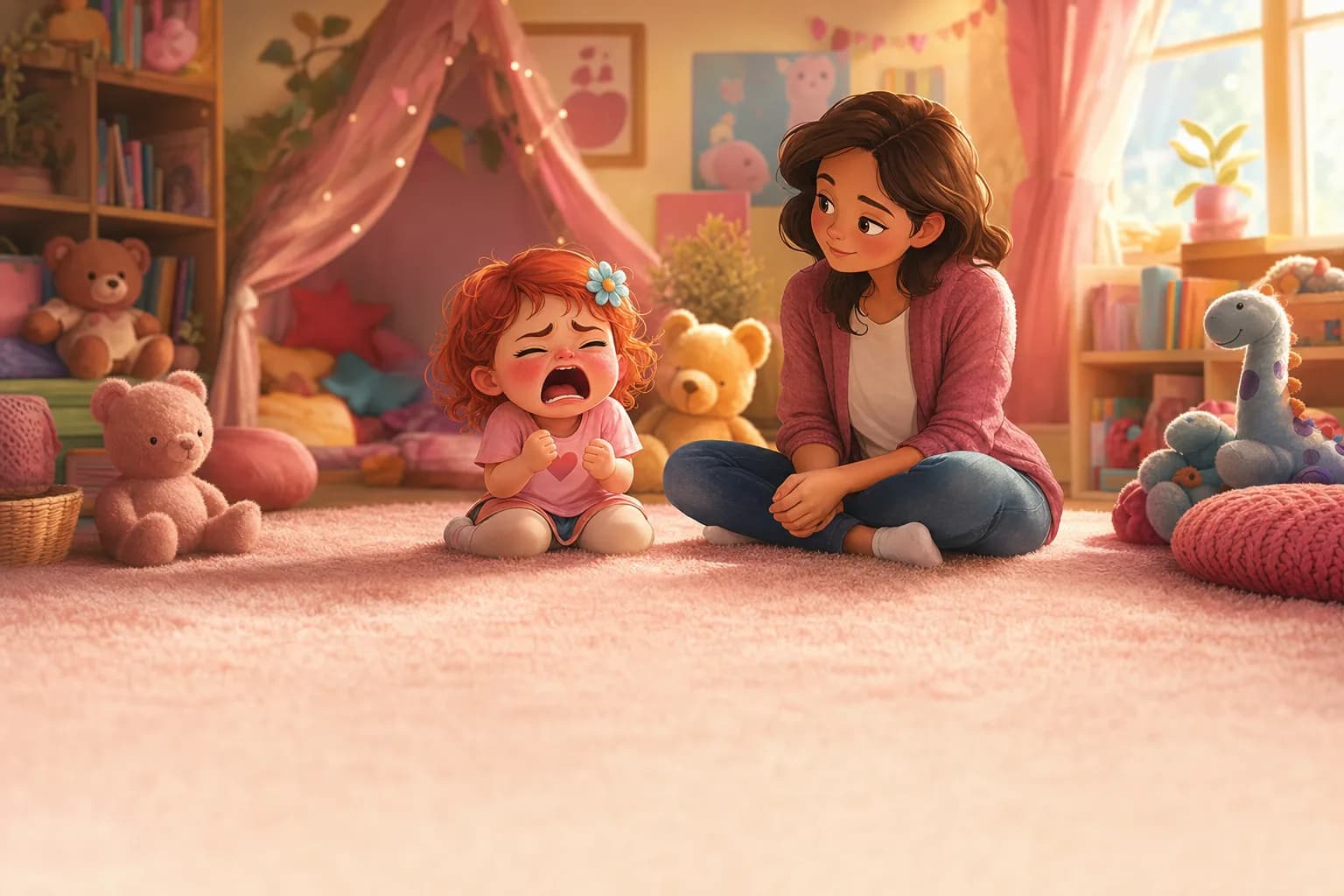
Last updated: 23 July 2026
It's not a verdict on your parenting
Your toddler is flat on the supermarket floor, screaming because you said no to the biscuits. Strangers are looking. It feels like everyone can see exactly how badly you're doing at this. Here's the truth from people who watch this happen every single day: a tantrum is not a sign of a bad child or a bad parent. It's a sign of a brain that is still being built.
Between roughly 18 months and 4 years, almost every child has tantrums — driftbuien. They are near-universal and they are temporary. Understanding what's actually happening under the noise turns those moments from a personal failure into something you can meet with a bit of calm and a plan.
The brain behind the tantrum
A tantrum happens in the gap between what a toddler wants and their still-growing ability to manage the feeling or find the words. The part of the brain that helps us pause, wait and calm ourselves down — the prefrontal cortex, the "thinking brain" — is still developing in these years and not yet well connected to the parts that feel big emotions. Toddlers do have this brain area; it's simply immature. Until roughly age 3½ to 4, a child can often repeat a rule but still can't reliably stop themselves from acting on a strong impulse. That's not defiance. That's construction in progress.
What's really going on
- The "brakes" of the brain aren't finished — impulse control is one of the last things to develop
- Big feelings arrive faster and louder than the words to describe them
- Frustration builds when a task is too hard, a wish is denied, or a moment is too chaotic or exciting
- None of this means the child is manipulating you — the distress is usually real
Borrowed calm: co-regulation
- Self-regulation isn't something toddlers are born with — it's built through calm, responsive back-and-forth with adults
- In the moment, a child literally borrows your regulated nervous system: your calm becomes their calm
- Every time you stay steady through a storm, you're helping wire the very circuits they'll later use on their own
- This is the long game — repeated calm cycles, not any single perfect response, are what teach self-regulation over time
What's normal: the tantrum years
~12–18 months
The first storms
Tantrums usually begin around this age, as a child's wants start outrunning their words. Early on they're often short bursts of frustration.
~2–3 years
The peak ("peuterpuberteit")
This is the high point — the era English speakers call the "terrible twos" and the Dutch fondly call peuterpuberteit, toddler puberty. Wanting to do everything themselves collides daily with not yet being able to. Tantrums are most frequent here, and a meaningful minority of children have them daily. That's within the normal range.
~3–4 years and up
The wind drops
As language and impulse control grow, tantrums become less frequent and easier to head off. By around age 4 they are far less common. They don't vanish overnight, but the trend is clearly downward.
During a tantrum
Anger first, then sadness
Tantrums have an inner shape: anger tends to spike hard and early, then fades into distress and sadness. This is why comfort often "bounces off" at the start but lands beautifully a minute later — you're waiting for the anger to burn down before the need for closeness surfaces.
Before, during & after: what actually helps
You can't prevent every tantrum, and you don't need to. But a few well-grounded habits genuinely lower the odds, help you steer through the moment, and repair the connection afterwards. This is exactly the rhythm we use across a busy daycare day.
Before — lower the odds
PreventionMost tantrums have fuel behind them: a tired, hungry, or overstimulated child with no felt sense of control. Protecting the basics and offering small choices removes a surprising amount of the fuel.
- Protect sleep and regular meals — hunger and tiredness are the two biggest triggers
- Keep routines predictable; a child who knows what comes next carries less stress
- Warn before transitions: "Two more minutes, then we put on shoes"
- Offer small, real choices: "Blue cup or green cup?" — a felt sense of control
- Give warm attention when things are calm, not only when things go wrong
During — be the calm
In the momentOnce a tantrum is in full flow, this is not the moment for teaching or reasoning — the thinking brain is offline. Your job is safety and calm presence, not a lesson. Fewer words, lower voice, stay near.
- Keep yourself calm first — your dysregulation feeds theirs, your calm settles theirs
- Get down to their level; use short, clear sentences and few of them
- Name the feeling simply: "You're so angry we said no"
- Lower the stimulation — move a supermarket meltdown to a quieter spot, not as punishment but as relief
- Stay near even if they can't accept comfort yet; you are the anchor
- Step in physically only for safety — hitting, biting, running toward danger — calmly, never as punishment
- Don't give in to the specific demand (the biscuit); you can hold the boundary and offer comfort at the same time
After — reconnect & repair
ReconnectionWhen the storm passes, the child comes back needing you — not a post-mortem. A short, warm reconnection is what closes the loop and, over hundreds of repetitions, teaches them how to come back to calm themselves.
- Offer a hug and a simple "That was hard. It's over now. I'm here"
- Skip the lecture — a just-calmed toddler still can't process a lesson
- If there's anything to teach, keep it tiny and save it for a calm moment later, if at all
- Model repair: this ordinary cycle of upset-and-reconnect is how self-regulation is built over time
A note on evidence
- Protecting sleep/meals and giving advance warning before transitions are the best-supported strategies, echoed across the NHS, the AAP, Zero to Three and the Dutch NJi.
- Staying calm yourself (co-regulation) rests on strong developmental-neuroscience evidence.
- Small choices, naming feelings and warm reconnection are consistent professional advice, grounded more in clinical experience and theory than in trials on tantrums specifically — sensible practice, not iron law.
Real things to say (when your own words vanish)
In the heat of a tantrum, most parents' minds go blank. Here are short, ready-made lines — drawn from NHS, NJi and Zero to Three guidance — that name the feeling, hold the boundary and offer safety, all at once. Keep them short. Say them slowly.
Name the feeling
Connect first"You really wanted the cookie. You're so angry we said no."
Offer safety and presence
Stay near"I'm right here. It's okay to be upset. I'm going to wait with you."
Hold the boundary, kindly
Boundary + warmth"I won't buy the sweets today. And I'll help you when you're ready."
Keep unsafe behaviour safe
Safety only"I won't let you hit. I'm keeping us both safe."
Reconnect afterwards
Repair"That was hard. It's over now. Shall we have a cuddle?"
Say less than you think
- Short sentences work better than long explanations — during high arousal the reasoning brain isn't available.
- You don't have to fix the feeling or make it stop; naming it and staying near is enough.
- Your tone carries more than your words. A calm voice does most of the work.
Tantrum or meltdown? A gentle word
You may have read about the difference between a "tantrum" and an autistic "meltdown." It's worth understanding the distinction — but it is not a home diagnosis. Young children, especially those who don't have many words yet, can look very similar in either case, and only a professional can make sense of a fuller picture. Think of the patterns below as things to notice and, if they worry you, to talk over with the consultatiebureau or your huisarts — never as a checklist to label your own child.
Patterns often described
- A tantrum is usually tied to a want or goal ("I want the biscuit") and often eases once the situation shifts
- A meltdown is more often driven by overwhelm or sensory overload than by a goal, and isn't shaped by reward or consequence
- Meltdowns can be preceded by self-soothing signs (covering ears, rocking) and may last considerably longer
- These are tendencies, not tests — real children overlap, and one hard episode tells you very little
If you're wondering
- Notice patterns over time rather than reacting to a single hard day
- Bring what you're seeing to the consultatiebureau/JGZ — that's exactly what they're there for
- Ask us too: caregivers see your child in a group setting and can share what they notice
- Trust that asking early is never over-reacting — it's just gathering more eyes on the picture
Myths, busted
A few sticky beliefs make tantrums harder than they need to be — and can nudge caring parents into responses that don't actually help. Here's what the developmental evidence says instead.
"They're doing it to manipulate me"
MythManipulation requires exactly the kind of planning and impulse control a toddler's brain hasn't built yet. A tantrum is far more often genuine distress from a system that's overloaded than a calculated performance. Meeting it as real — even while you hold your boundary — fits what's actually happening in their brain.
"Comforting a tantrum just rewards it"
MythThere are two different things here. Giving in to the demand that started it — buying the sweets, dropping the boundary — is what teaches "tantrum gets me the thing." Comforting the child's overwhelmed nervous system is a different mechanism entirely, and it isn't shown to make tantrums more frequent. You can comfort the feeling and still hold the line on the demand — at the same time.
"A well-raised child doesn't have tantrums"
MythTantrums are near-universal in these years, across cultures and parenting styles. Their presence is a sign of a normally developing toddler, not of a discipline failure. What changes with a calm, consistent home isn't whether tantrums happen — it's how supported the child feels moving through them.
When to talk to the consultatiebureau
The vast majority of tantrums need no professional at all — just time, calm and the child growing into their own brakes. But you know your child best, and there's never a wrong time to ask for a second pair of eyes. The consultatiebureau (JGZ) exists exactly for questions like these, and reaching out early is a strength, not an overreaction. These are qualitative signals worth a conversation, not fixed thresholds — trust your gut over any number.
Signals worth a conversation
- Tantrums stay intense and very frequent well beyond the years you'd expect them to be easing (past about age 4–5)
- Your child struggles to calm even with sustained, patient co-regulation over time
- There's regular self-injury, or injury to others, that you can't keep safe
- You notice a loss of language or skills the child previously had
- The intensity seems consistently far out of proportion to the trigger
- You, as the parent or caregiver, feel unable to cope — that alone is reason enough to ask for support
Frequently asked questions
Should I use a time-out?
This is one of the genuinely debated points in parenting, and reputable experts disagree — so we won't tell you there's one answer. One camp points to decades of behavioural research showing a short, calm, consistent time-out (paired with teaching the better behaviour) is an effective, non-physical tool, and the AAP still endorses it. Another camp argues there's little evidence it adds much beyond simply avoiding physical punishment, that it's very easily done wrong (turning into isolation), and that stepping away can withdraw exactly the calm a young child needs. A common middle path is a "time-in" or cozy corner — a calming space used with the child or nearby, rather than isolation. Choose what fits your family and your child; there's no single "science-approved" answer here.
Should I ignore the tantrum or engage with it?
Also genuinely contested. The classic behaviourist view is to ignore the tantrum behaviour (not the child), intervening only for safety, so as not to reinforce it with attention. Attachment-informed sources argue that because much of a tantrum is real distress rather than a bid for attention, some presence and naming of the feeling is appropriate even before the child can be reasoned with. Notably, both camps agree on one thing: don't give in to the specific demand. Where they differ is whether emotional presence during the tantrum is "reinforcing" or "necessary co-regulation." This is the most contested tactical point in the field — read it as unsettled, and lean on what your own child responds to.
Can I use a screen to calm a tantrum?
A screen can stop a tantrum in the short term, but leaning on it regularly means a child gets less practice riding out and recovering from big feelings with your help — which is how self-regulation is built. Occasional use in a genuinely tough spot isn't a catastrophe; a habitual off-switch has a tradeoff worth being aware of. Guidance here leans toward "sparingly, and with the tradeoff in mind" rather than a flat rule.
How long is a "normal" tantrum?
Shorter than it feels. Most tantrums are brief — often a minute or two, and the large majority are over within about five minutes, though they tend to last a little longer as children get older. There's a wide normal range, so an occasional longer storm isn't cause for alarm on its own.
Why is my child fine at daycare but melts down the moment I pick them up?
This is incredibly common — and it's actually a good sign. Holding it together in a group all day takes enormous effort for a little brain. You are their safe place, so the moment they see you, all the feelings they've been managing come pouring out. It isn't a sign the day went badly or that they're punishing you; it's the relief of finally being with the person they trust most. Expect a wobbly reunion and meet it with calm.
Am I making it worse by staying calm — shouldn't I show it's serious?
Staying calm is not the same as being passive or permissive — you can hold a firm boundary in a warm, quiet voice. Matching your child's big emotions with big emotions of your own usually pours fuel on the fire, because they take their regulation cues from you. Calm firmness gives them something steady to borrow from. It's the hardest thing to do and the most effective.
Where to read more
Calm, reputable places to learn more — Dutch and international. If a question is about your specific child, always start with the consultatiebureau or your huisarts.
- NJi — Peuter: driftbuien, omgaan met heftige emoties
- NHS — Temper tantrums
- HealthyChildren.org (AAP) — Top tips for surviving tantrums
- Zero to Three — Toddler tantrums 101
- Harvard Center on the Developing Child — Serve and return
- JGZ-richtlijnen — the Dutch youth-health guidelines
- Your consultatiebureau (JGZ) — and, always, us
About this guide
This guide is for educational purposes and reflects current developmental-science consensus and reputable parenting guidance, drawn from sources including the NHS, the AAP, Zero to Three, the Harvard Center on the Developing Child and the Dutch NJi. It is not medical or psychological advice and can't replace knowing your own child. Where parenting approaches genuinely disagree — such as time-outs — we've described the debate rather than picking a side. If your child's tantrums worry you, or you simply want another perspective, talk to your consultatiebureau (JGZ) or huisarts. Teddy Kids has no commercial affiliation with any organisation or product named here.
Teddy Kids is here for you
As your twins grow, we grow with you — with warm, bilingual childcare in Leiden.