File 07 · Food
The Honey Files
Two grown-ups we know got into an argument at breakfast. One said honey is “just sugar in a fancy outfit”. The other said it is a natural medicine that can fix almost anything. They both sounded so sure. So we did what Teddy Lab always does: we read the research — all of it — and gave every claim an honest verdict.

The five claims, verdicted
Five claims, five verdicts. Here is what the research actually says.
1.Honey is just sugar in a different format.
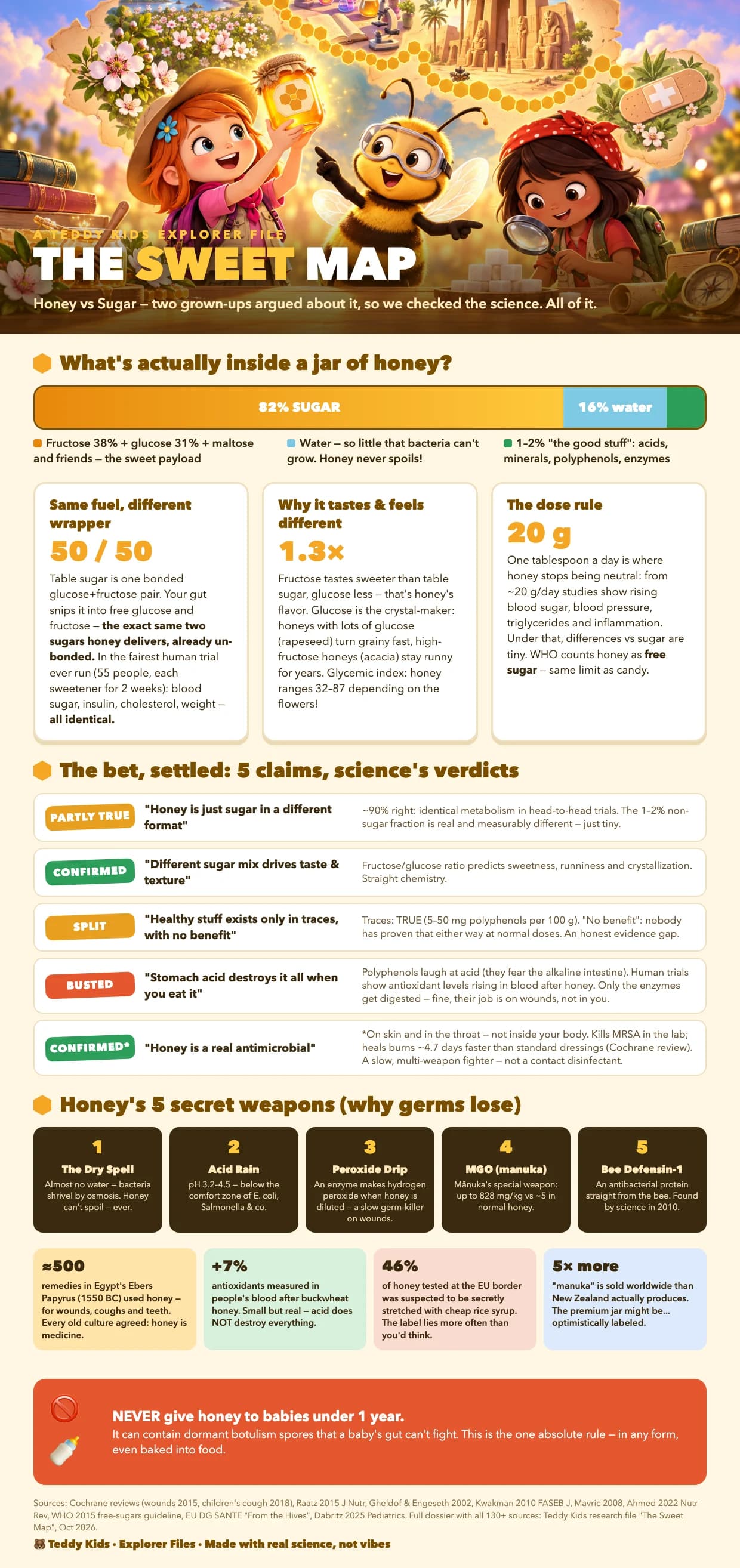
PARTLYMostly true: honey is about 82% sugar, and in the best head-to-head human trial it raised blood sugar, insulin, cholesterol and weight exactly like table sugar and corn syrup. But the small non-sugar fraction really does behave differently in tests.
2.Honey’s sugar mix (fructose + glucose instead of one bonded sugar) is why it tastes and feels different.
CONFIRMEDConfirmed: honey is roughly 38% free fructose and 31% glucose, while table sugar is one bonded 50/50 molecule. That ratio explains the sweeter taste, the thick texture and why some honeys turn grainy while others stay runny for years.
3.The healthy substances in honey are only traces, so eating it brings no benefit.
SPLITSplit verdict. The “only traces” part is confirmed: 5–50 mg of polyphenols per 100 g and 1–3% of daily vitamins. The “no benefit” part is an evidence gap — antioxidants do rise in the blood, but only at doses around 100 g a day. At a normal spoonful, no trial shows a benefit.
4.Stomach acid destroys everything in honey the moment you swallow it.
BUSTEDBusted: polyphenols survive gastric acid fine — lab digestion found 78–112% still available, and human trials measured 7% more antioxidants in the blood after honey. Only the enzymes break down, and their job (making germ-killing peroxide) was never meant to happen inside you anyway.
5.Honey is a real antimicrobial — it works like a disinfectant.
CONFIRMEDConfirmed, with a caveat: in the lab, honey kills MRSA, VRE and resistant Pseudomonas through several mechanisms at once, and it genuinely helps burns and cough. But it is a slow, high-concentration growth inhibitor — hours to kill, not seconds — and it works on your skin and in your mouth, not inside your body.
What a jar of honey actually is
Take 100 grams of honey: about 82 grams is sugar — 38 grams fructose, 31 grams glucose, plus a little maltose and sucrose. About 17 grams is water, and so little that bacteria cannot grow in it: honey basically cannot spoil. Everything else together — acids, minerals, polyphenols, enzymes, traces of vitamins — is 1 to 2 grams. Table sugar? 100 grams of sugar, full stop.
That tiny extra fraction is why honey tastes about 1.2 to 1.5 times sweeter than sugar per gram, and why high-glucose honeys turn thick and grainy while high-fructose ones stay runny for years. One surprise: the glycemic index of honey is not one number — it ranges from 32 to 87 depending on the flowers. And the rule-makers treat honey as sugar, full stop: the WHO counts it as free sugar, the FDA as added sugar, and the EU has approved exactly zero health claims for it.
Your body: honey vs sugar
The cleanest experiment is Raatz 2015: 55 adults spent separate periods getting 50 grams of carbohydrate a day as honey, table sugar or high-fructose corn syrup. The result: blood sugar, insulin, blood fats, weight and blood pressure were all identical. All three raised triglycerides. In the best direct comparison, your body cannot tell them apart.
But dose is the real story. A big 2025 umbrella review of 69 trials found: up to about 10 grams a day (two teaspoons) there may be a small benefit. From 20 grams a day — one tablespoon — it tips the other way: fasting blood sugar rises, blood pressure creeps up, triglycerides climb and inflammation markers go up. The honest rule of thumb: a teaspoon is fine, a tablespoon counts as candy.
Where honey is real medicine: on you, not in you
Honey attacks germs in five ways at once: it squeezes them dry, its acids keep the pH too low to grow, dilution switches on a slow-release peroxide, manuka honey adds methylglyoxal, and bees put a bacteria-fighting peptide (defensin-1) in it. In the lab, 10–20% honey kills MRSA and other superbugs — and so far, no bacterium has become resistant to honey.
The strongest clinical result: partial-thickness burns. A Cochrane review of 26 trials (3,011 people) found honey dressings heal burns about 4.7 days faster than standard dressings. Honey also genuinely calms a child’s night-time cough — about as well as common cough syrup — which is why health authorities list it as self-care for children over one. But the largest leg-ulcer trial (368 people) found no benefit, and a honey “disinfectant” is overpromising: it takes hours, not seconds.
Manuka reality check: its special chemistry is real, and its wound evidence is the best of all honeys. Eaten, though, the magic mostly does not reach you — in the only human trial against stomach bacteria, all 12 patients stayed infected. Then look at the shelf: about 1,700 tonnes of genuine manuka are produced in New Zealand each year, while roughly 10,000 tonnes are sold worldwide as “manuka”. Eaten manuka is the most expensive sugar-water in the supermarket.
Sweet facts to drop at breakfast
- Ancient Egyptian doctors wrote down about 500 honey remedies — around 1550 BC. Honey has been medicine for at least 3,500 years.
- In human trials, blood antioxidant levels rose 7% after buckwheat honey — real, but tiny compared with eating vegetables.
- EU border inspectors suspected 46% of tested imported honey of being adulterated — stretched with cheap rice or wheat syrup.
- About five times more “manuka” honey is sold worldwide than is produced in New Zealand.
Sources
- Raatz 2015, J Nutr (PMID 26338891)
- Ahmed 2022, Nutrition Reviews
- Gholami 2022, British Journal of Nutrition
- Norouzzadeh 2025, umbrella dose-response review (69 RCTs)
- Gheldof & Engeseth 2002, J Agric Food Chem
- Gheldof 2003 (PMID 12590505)
- Schramm 2003
- Kwakman 2010, FASEB J (PMID 20228250)
- Mavric 2008 (PMID 18210383)
- Cochrane 2015 review CD005083 (burns)
- Cochrane 2018 cough review
- McGovern 1999 (manuka, H. pylori)
- Harris & Dabritz 2024, infant botulism (PMC11322261)
- EU DG SANTE “From the Hives” report (2021–22)
- WHO 2015 sugars guideline
- NICE guideline NG120
- EFSA Journal 2011;9(6):2243
Quiz each other
Five questions from this File — the answers are right there, so read them out loud together.
1.How much of honey is sugar?
About 82%. The rest is mostly water, plus 1–2% of acids, minerals, polyphenols and enzymes.
2.In the best head-to-head trial, how did honey do against table sugar for blood sugar, insulin and weight?
Identical. Your body processes honey and table sugar the same way.
3.Where does honey work as real medicine — inside your body or on it?
On it: burns heal about 4.7 days faster with honey dressings, and it calms a child’s cough. Swallowed manuka barely reaches you at all.
4.Why is honey off-limits for babies under 12 months?
Botulism spores in honey can grow in a baby’s immature gut. After the first birthday the gut handles them fine.
5.How much more “manuka” is sold than is produced?
About five times more. Around 1,700 tonnes are produced in New Zealand each year, while about 10,000 tonnes are sold as manuka.