File 08 · Food
The Juice File
A glass of juice looks so innocent. Fruit on the label, vitamins in the ad, “no added sugar” on the box. But one of our grown-ups said juice is “soda wearing a fruit costume”, and another said it is a healthy way to get fruit into kids. We checked every claim — and the truth turned out to be more interesting than either of them.

The eight claims, verdicted
Eight claims, eight verdicts — including two surprises.
1.Juice is basically soda.
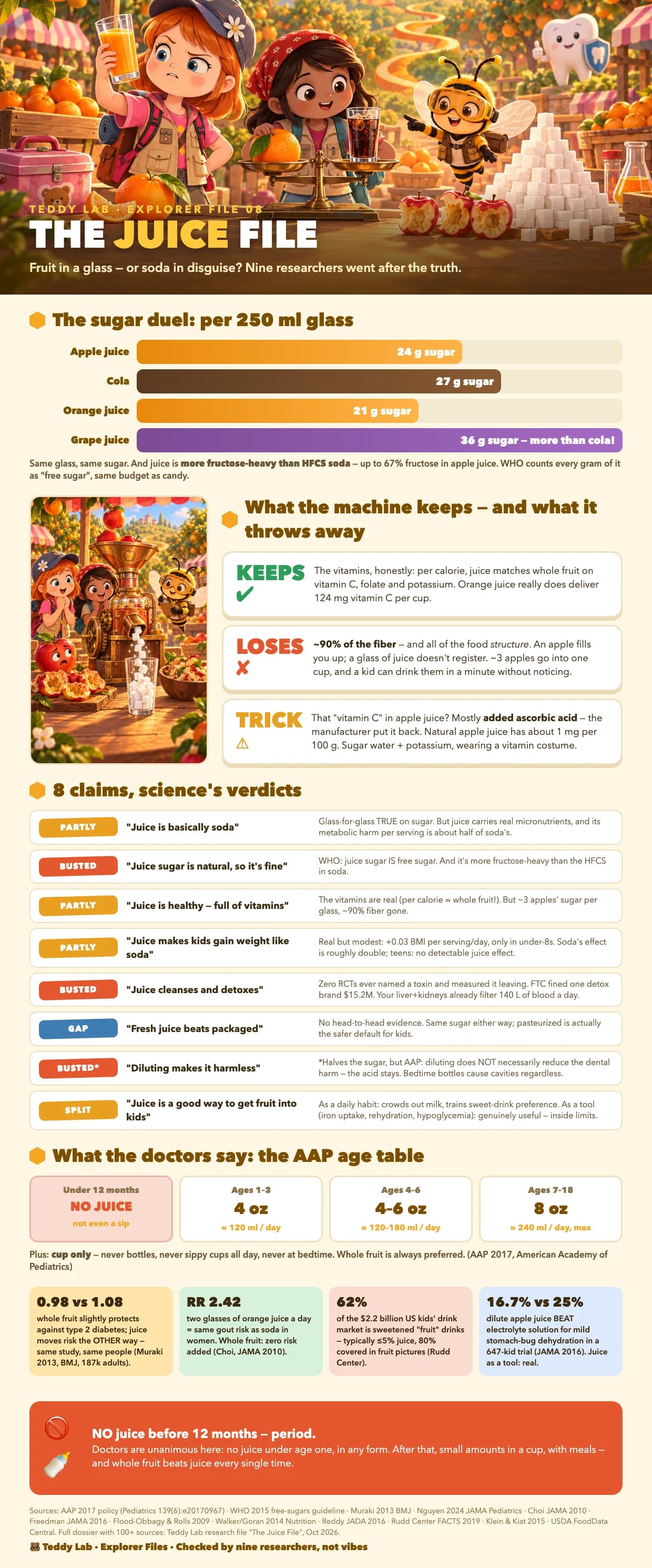
PARTLYGlass for glass, true on sugar: apple juice has 24 g per 250 ml against cola’s 27 g, and grape juice has 36 g — more than cola. But juice does deliver real micronutrients soda does not, and its metabolic harm per serving is roughly half of soda’s.
2.Juice sugar is natural, so it is fine.
BUSTEDBusted: the WHO counts juice sugar as free sugar — the same daily budget as added sugar. And juice is even more fructose-heavy than soda: up to 67% of apple juice’s sugar is fructose.
3.Juice is healthy — full of vitamins.
PARTLYPartly: the vitamins are real — per calorie, juice roughly matches whole fruit. But one glass carries the sugar of about three apples with around 90% of the fibre stripped out. And the vitamin C in apple juice? Mostly added ascorbic acid — it was never in the apple.
4.Juice makes kids gain weight like soda does.
PARTLYPartly: the effect is real but smaller and mostly in young children — about +0.03 BMI points per daily serving, significant under age 8, not detectable in teens. Soda’s effect is about twice as large.
5.Juice cleanses and detoxes the body.
BUSTEDBusted hard: not a single cleanse trial has ever named a toxin and measured it leaving. The US Federal Trade Commission fined one juice-cleanse company $15.2 million for detox claims. Your liver and kidneys filter about 140 litres of blood a day — the detox system ships installed.
6.Fresh juice beats packaged juice.
EVIDENCE GAPEvidence gap — mostly marketing. Nobody has run a proper head-to-head trial, and the sugar is the same either way. For kids, pasteurised juice is actually the safer default: it cannot carry the germs fresh juice sometimes can.
7.Diluting juice makes it harmless.
BUSTEDBusted for teeth, only half-true for sugar. Diluting halves the sugar, yes — but dentists warn it does not necessarily reduce the acid damage to enamel, and a bedtime bottle of even diluted juice is the classic recipe for cavities.
8.Juice is a good way to get fruit into kids.
PARTLYBusted as a daily habit, confirmed as a tool. As an everyday drink it crowds out milk and teaches a sweet-drink habit. But used for a job — iron absorption, rehydration after a stomach bug, low blood sugar, constipation dosing — small amounts inside the age limits are genuinely useful.
The sugar duel: juice vs cola
Per 250 ml: apple juice 24 g of sugar, cola 27 g, orange juice 21 g, grape juice 36 g. Grape juice beats cola. The “natural” sugar counts exactly like added sugar in your body’s budget — and apple juice can be up to 67% fructose, more fructose-heavy than cola.
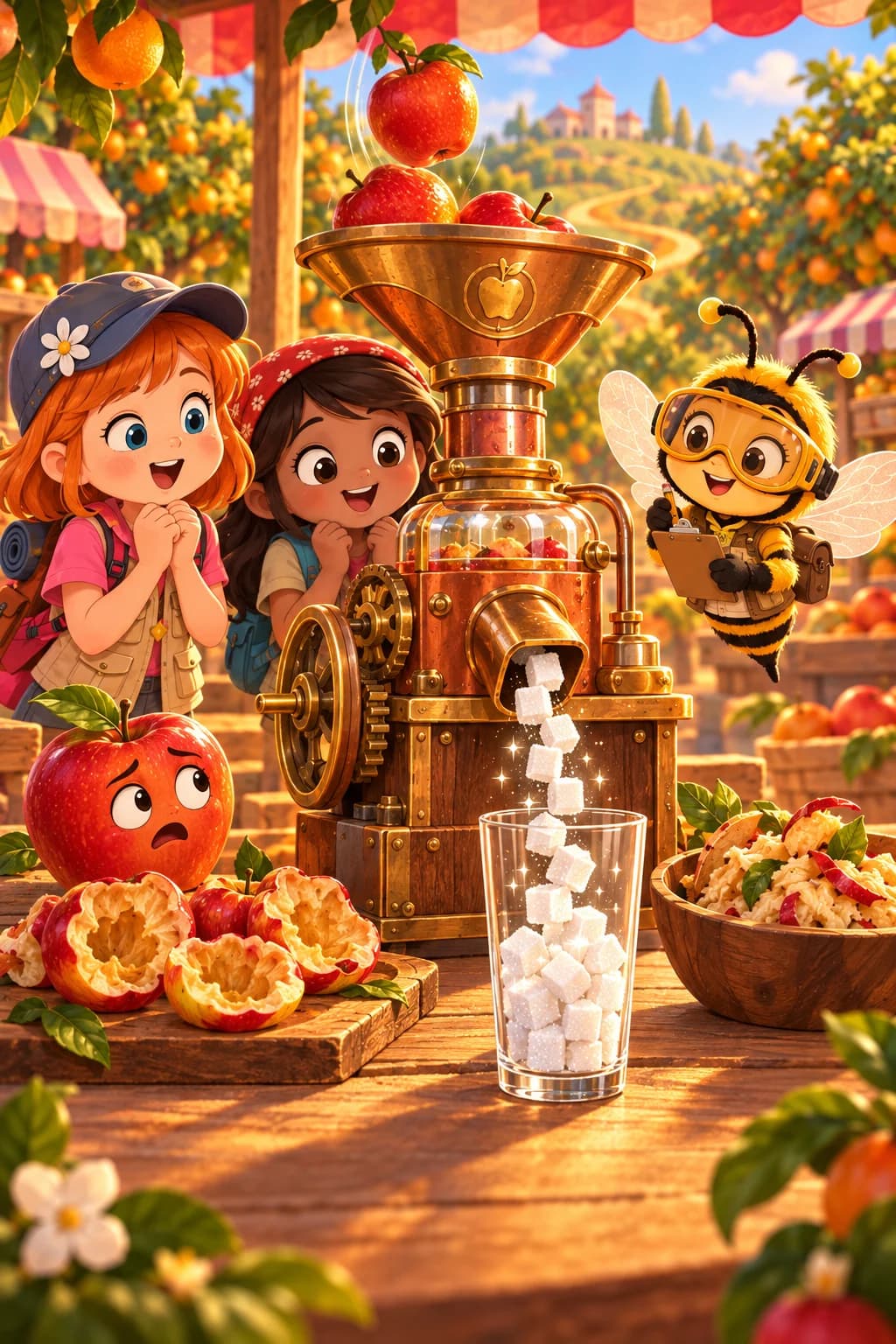
Here is what the machine keeps, and what it loses. It keeps the water and most of the vitamins — per calorie, juice genuinely matches whole fruit on vitamin C, folate and potassium. It loses the structure: about 90% of the fibre stays behind in the pulp, and with the fibre goes the feeling of fullness. That is why a child can drink three apples’ sugar in one sitting and still ask for lunch.
What the doctors say: age limits
The American Academy of Pediatrics is crystal clear. Under 12 months: no juice at all — not even diluted. After that, juice is a small, with-meals treat in a cup, never a bedtime bottle. That delivery rule matters most of all: bottles and bedtime are where the cavities come from.
| Age | Maximum per day |
|---|---|
| Under 12 months | No juice at all |
| 1–3 years | 4 oz (120 ml) |
| 4–6 years | 4–6 oz (120–180 ml) |
| 7–18 years | 8 oz (240 ml) |
A cup with meals, never a bottle at bedtime — and diluting does not fix the acid.
The honest wins (yes, there are some)
Vitamin C multiplies how well your body absorbs iron from plants — two to six times better — so a small glass of orange juice with a meal genuinely helps kids who need iron. Whole fruit does the same job, but juice does it too.
When a stomach bug hits, half-strength apple juice works: in a 2016 trial of 647 children, diluted apple juice failed less often than the special electrolyte drink — 16.7% against 25%. And when blood sugar crashes, four ounces of juice is an official rescue option for kids with diabetes (the 15-15 rule: 15 grams of fast sugar). Prune juice even has a published dosing for constipation. Juice is a tool — a useful one, in the right dose.
Detox: the claim that dies on contact
Zero randomised trials of juice cleanses exist. Not one has ever named a toxin and measured it leaving the body. When scientists asked fifteen detox-product makers to define “toxin”, none could. The one study often quoted had 20 people, no control group and measured no toxin at all — and a 2025 study found three days of juice-only eating actually shifted gut bacteria toward inflammation.
The regulator’s answer is on record: the US Federal Trade Commission fined Teami $15.2 million for detox claims. Meanwhile your kidneys filter around 140 litres of blood every day, and your liver runs more than 500 jobs. The cleanse you are being sold is already installed — for free.
Sources
- Muraki 2013, BMJ
- Nguyen 2024, JAMA Pediatrics
- Freedman 2016, JAMA (PMID 27131100)
- Choi 2010, JAMA
- Walker, Dumke & Goran 2014, Nutrition (PMID 24985013)
- Flood-Obbagy & Rolls 2009 (PMC2664987)
- Almiron-Roig 2013 (PMC3746122)
- AAP 2017, Pediatrics 139(6):e20170967
- WHO 2015 sugars guideline
- Healthy Drinks Healthy Kids 2019
- NHS 5-a-Day
- Klein & Kiat 2015 (detox review)
- FTC v. Teami 2020
- USDA FoodData Central
Quiz each other
Five questions from this File — the answers are right there, so read them out loud together.
1.Which has more sugar per 250 ml — grape juice or cola?
Grape juice: 36 g against cola’s 27 g. Apple juice sits close behind cola at 24 g.
2.How much of the fibre survives juicing?
About 10% — roughly 90% stays behind in the pulp.
3.How many apples’ sugar is in one glass of apple juice?
About three apples per glass — without the fullness that eating them would give you.
4.What do the doctors say about juice for babies under 12 months?
None at all — no juice before the first birthday.
5.What happened to the company that claimed juice cleanses detox your body?
The FTC fined Teami $15.2 million — the largest fine of its kind.