Pedagogical Approach for Daycare
Last updated Mei 2024
Welcome to Teddy Kids!
Dear Parents,
This Pedagogical Approach document will give you a feel for the Teddy Kids Promise, and our teaching philosophy, how we develop the children’s cognitive skills, motor skills, language skills and social skills—all while having lots of fun!
A little about us: We are the international daycare in Leiden that provides first-class care to children ages 0 through 9. We are a warm, inviting, comfortable childcare centre with personality that values flexibility. Our varied background and years of experience allow us to accommodate the needs and customs of children and parents alike. We strive to make children and parents feel at home here.
Our directors, managers, teachers, interns, students and support staff are hard at work every day to deliver on the Teddy Kids Promise:
- 1)Flexibility! We want to create a childcare schedule that works for your family and that’s easy to change or add days whenever something comes up. And we’re so flexible that we apply no cancellation fee if you need to end your contract. We also accommodate children’s nutritional needs, and we are open-minded when it comes to embracing our families’ many cultures and customs.
- 2)Quality teachers and curriculum. Our pedagogical staff are trained, energetic, creative and loving. And more than 50% of them are permanent staff! Our teachers design a full educational and entertaining programme for our children.
- 3)The best nutrition through warm, balanced lunches, healthy snacks, and table manners, too!
- 4)International culture complete with Dutch- and English-speaking pedagogical staff in every group.
You can find this document at our different locations in an easy-to-reach spot on the information board, and online at teddykids.nl/en/policy/pedagogical-policy.
We’re always ready to go the extra mile to ensure that parents and caretakers get the assistance they need, when they need it. Feel free to contact us at any time: info@teddykids.nl.
Thank you for choosing Teddy Kids! We can’t wait to meet your little one!
Your Teddy Kids Family
Pedagogical staff & Group composition
Pedagogical staff
Teddy Kids is proud to have permanent staff for every group. More than 50% of pedagogical staff members have been with us for more than five years, and some even from the beginning!
The children are cared for by an international team of qualified teaching staff, certified according to the Collective Bargaining Agreement (collectieve arbeidsovereenkomst, or CAO in Dutch) for Daycares. Furthermore, Teddy Kids is an accredited staff training institution, and employs numerous students who work under the guidance of our trainee supervisors.
While 50%+ of our pedagogical staff are permanent employees, you can expect to meet new pedagogical staff in the event of vacations, leave of absence or illness. We strive as much as possible to provide continuity for the children with pedagogical staff they recognise.
Staff-to-child ratio
The staff-to-child ratio at Teddy Kids follows the laws of Innovation and Quality of Childcare (Innovatie en Kwaliteit Kinderopvang, or IKK in Dutch):
- 1 pedagogical staff member per 3 children up to age 1
- 1 pedagogical staff member per 5 children ages 1 - 2
- 1 pedagogical staff member per 8 children ages 2 - 3
- 1 pedagogical staff member per 8 children ages 3 - 4
*Interns, activity leaders and assistant teachers are not counted towards the regular pedagogical staff-to-child ratio in a group.
Code of Conduct for Multilingualism
Introduction
Since 2004, Teddy Kids has been part of the internationalization efforts in Leiden. For over 16 years, we have been providing bilingual childcare services to national and international families in the Leiden area. We have observed a growing demand for bilingual childcare and have even been asked to consider opening childcare facilities in other municipalities.
Objective
By offering simultaneous language acquisition, we provide children with an advantage in their language development. Additionally, we consider it essential for different beliefs, cultures, customs, and origins to coexist harmoniously. We strive to create a pleasant environment for everyone, where unity is central. This is achieved by accommodating various needs and customs, which can range from small to significant gestures. It is important for us to align with parents' wishes regarding childcare so that both children and parents feel comfortable. Based on experience, Teddy Kids understands how challenging the transition from one's home country to the Netherlands can be. We endeavor to welcome everyone at Teddy Kids and provide a sense of belonging. We aim to assist parents and children in transitioning to a new home country. By incorporating different languages, cultures, beliefs, and customs at Teddy Kids, and by respecting and acknowledging them, children learn to embrace the diversity of this wonderful world. They learn at an early age to navigate two languages and various backgrounds, learning to accept and adapt to them. Teddy Kids strives to raise children as global citizens, capable of feeling at home anywhere in the world due to their knowledge of the English language and familiarity with various customs.
Guidelines
- Childcare workers who speak English must have a minimum of B2 level proficiency in English. Dutch-speaking childcare workers must have a minimum of B2 level proficiency in Dutch.
- The childcare environment consists of 50% Dutch and 50% English communication. Activities are also offered 50% in English and 50% in Dutch throughout the week.
- Childcare workers speak their native language to the children and among themselves.
- Typically, each group has a fixed Dutch-speaking and a fixed English-speaking childcare worker. However, there are exceptions:
- If a childcare worker is sick.
- If a childcare worker is on vacation.
- In such cases, there will always be a familiar face on the group that all children know and trust.
- Each location has a Dutch-speaking head teacher who is available to step in when needed. She is familiar with all the children.
- Each location has multiple Dutch-speaking interns who, if in their second year or higher, can cover for sick or vacationing staff.
- At least two childcare workers are always present in the building, also for the "four eyes" principle, and there will always be a childcare worker fluent in both languages.
- During break periods, there is always a childcare worker present who is proficient in both English and Dutch.
- English-speaking childcare workers have the opportunity to receive Dutch language courses at the expense of Teddy Kids, ensuring they have a basic understanding of the Dutch language.
- Activities are offered in both English and Dutch.
Communication with Parents
- Newsletters are sent in English and Dutch to all parents.
- Daily stories on WhatsApp are written in English.
- Important information is communicated in both English and Dutch.
Language Proficiency Checks
- Once a year, the speech therapist visits to observe all children regarding their speech and language proficiency.
- The speech therapist provides us with forms each year to monitor the language proficiency of the children.
- We maintain close communication with the speech therapist (Willemijn). If we have concerns about children, we can consult with her and potentially refer parents to her.
Deviations from the staff-to-child ratio
According to the laws of Innovation and Quality of Childcare (IKK), for a childcare centre with 10 or more consecutive open hours per day, the staff-to-child ratio may be reduced at certain points throughout the day but for no more than three hours per day. During the following hours there may be a deviation from the normal staff-to-child ratio (at least half of the required staff-to-child ratio will be observed during these instances):
Rijnsburgerweg (RBW)
0 - 1 year: 13:0 -16:00
1 - 4 years: 13:00 - 15:00
Rijnsburgerweg 3
3 plus groep: 13:00 tot 15:00
Zeemanlaan (ZML)
0-2: 7:30 - 8:00 | 13:00 - 15:00 | 18:00 - 18:30
2-4: 13:00 - 15:00 | 17:30 - 18:30
We have certified head teachers and activity leaders at each location. In the schedule these pedagogical staff are listed as ‘Extra’ but they also help during breaks when necessary.
Interns
There may also be interns in your child’s group who are following courses to become pedagogical staff members in the childcare sector. Interns may follow one of two vocational training paths (in Dutch beroepsopleidende leerweg, BOL; or beroepsbegeleidende leerweg, BBL). Both paths lead students to the same diploma; the difference is the amount of practical experience they undergo (a minimum of 20% for BOL; minimum of 60% of practical experience is required for BBL).
Employing interns and students is always done according to the terms of the CAO. Interns and students are not considered fully-certified pedagogical staff and therefore are never given sole responsibility of the children in a group.
In addition to the pedagogical staff, interns and students are considered extra for the group. According to the provisions within the CAO terms 2018 - 2019, a BOL intern may be considered a professional from the second year onwards in these instances:
- illness of a pedagogical employee;
- during school holidays;
- when taking the aptitude test as part of training.
The condition is that the intern can only work at their own internship location and that they cannot be alone in the group, except during breaks.
Graduating to certified professional pedagogical staff member for BBL occurs in phases and employability is determined by the employer based on the evaluation from the trainee's supervisor. Employability is rated from 0 to 100%, where 0 is not employable and 100 is fully employable as a professional. According to the terms of the CAO for Childcare 2012-2014, the commitment up to 100% can already be achieved after the first half year of study. In addition to the employability formation, the independence of the BBL intern also increases; as her education progresses, she becomes increasingly independent in performing her duties and functions as a permanent professional.
The BBL intern receives an apprenticeship contract. The student is therefore employed by the training company and receives a salary. BOL interns do not receive an employment contract but conclude an internship agreement.
Interns are authorised to pick up children from school, but only if they feel confident enough to do so and know the school well.
Volunteers
At Teddy Kids, we have volunteers who assist the childcare workers with daily tasks such as:
Household assistance: Volunteers help with a variety of daily tasks, including setting and clearing tables, washing dishes, managing laundry, restocking groceries, and ensuring a clean environment. These contributions ensure that the childcare facility operates smoothly and efficiently.
Outdoor activities: Volunteers participate in preparing and organizing outdoor play areas, including setting up and cleaning up toys, and ensuring a safe and enjoyable outdoor experience for the children.
Mealtime support: Volunteers assist during meals and snacks, ensuring that children eat and drink safely and comfortably. This may include helping with food and beverage distribution.
Safety and "4 Eyes" Policy: The safety of the children is our top priority. Volunteers may be involved in implementing the "4 Eyes" Policy, which promotes child safety through supervision. They may also participate in specific activities, such as woodworking, always under professional guidance.
Special activity pedagogical staff
In addition to our amazing pedagogical staff teaching and caring for the children on a regular basis, Teddy Kids employees several certified special activity leaders to introduce even more fun and educational programmes for the children. For children ages 1.5 - 4 years old, Teddy Kids offers music and singing lessons, dance lessons, exercise and yoga lessons—as part of our standard package. These activities are always designed with concrete concepts in mind for the age group of the children. The activities are offered in both Dutch and English languages.
Trainings for pedagogical staff
We are committed our staff’s professional development and to the betterment of our childcare service for your child. Therefore, every year we offer more and more workshops and trainings for our pedagogical staff.
Training for First Aid (EHBO) & Emergency Response Officer(BHV)
First Aid (EHBO) & Emergency Response Officer(BHV) courses are offered every year for our staff. At Teddy Kids it is our goal for 100% of our pedagogical staff to be First Aid certified.
There is always at least one person at your child’s location who is First Aid-certified. At every location there are at minimum two pedagogical or support staff members who are certified Emergency Response Officers.
Workshops and trainings
Our pedagogical staff attend the First Aid and Emergency Response courses every year, and a “lifting” course every year to learn to lift the children without injuring themselves.
Teddy Kids also offers the following additional trainings to raise our standards even higher:
2023
- EHBO training voor alle medewerkers. ( Engelstalig en Nederlandstalig)
- BHV training voor alle BHV ( minimaal 3 per locatie)
- Talkin Drawings
- Geweldloos communiceren ( Jess Koel)
- DISC cursus voor Tess van Overbeeke
- Gebarentaal cursus
2024
- EHBO training voor alle medewerkers. ( Engelstalig en Nederlandstalig)
- Babyslaap coach ( Federica Rijnsburgerweg 35)
- BHV training voor alle BHV ( minimaal 3 per locatie)
- Gezondheidscoach ( Claudia Rijnsburgerweg 35)
Additional support for pedagogical staff
The pedagogical staff meets all the applicable laws and regulations for childcare centres. They receive training in both the pedagogical field and for practical tasks such as fire prevention, handling illness and accidents, clear communication, etc. Each location holds regular staff meetings to discuss the pedagogical approach, changes to childcare rules and the management and implementation of these changes in practice. Besides consulting with management, teachers may also find answers to any questions via the Learning Support Service of Leiden website (Ambulante Educatieve Dienst, or AED www.aed-leiden.nl).
The children’s groups
Horizontal groups
At the Herenstraat, Rijnsburgerweg and Zeemanlaan daycare centres, we create horizontal groups, where children in a certain age group are placed together. This allows us to organise appropriate activities for every age group. Ages can vary, however, due to the individual level of the child and available places in the groups.
Vertical group
At our daycare centre at the American School of The Hague daycare, we work with a single vertical group. This group contains children aged 3 months to 3 years old. Permanent staff oversees the group at the ASH.
Group composition
Each group is limited to certain number of children. The numbers below are the maximum number of children allowed per group, according to age.
Rijnsburgerweg 35 (RBW)
- Elephants: Max. 6 children ages 0 - 1.5 years.
- Bears: Max 6 children ages 0 - 1.5 years.
- Flamingo. Max 12 ages 0-1.5 years
- Penguins: Max. 10 children ages 1-2 years.
- Giraffes: Max. 16 children ages 1 - 2 years.
- Pandas: Max. 16 children ages 2 -3 years.
- Monkeys: Max. 16 children ages 3 -4 years.
- Zebras: Max. 13 children ages 2 - 3 years.
(The maximum number of children allowed at this location is 82.)
Rijnsburgerweg 3
Rabbit: Max 16 kinderen ages 3-4 years.
Zeemanlaan (ZML)
- Koala: Max. 13 children ages 0 - 1.5 years.
- Bumblebees: Max. 14 children ages 1 - 2 years.
- Turtle: Max. 16 children ages 2 - 3 years.
- Cheeta’s: Max 16 children ages 2.5 - 4 years.
(The maximum number of children allowed at this location is 72.)
Occasionally merging groups
Sometimes it may prove necessary to merge certain groups; for example, when children’ attendance is unusually low due to vacation or illness. It’s very important to us that children are not confronted with too many strange faces and we do our best to ensure they are under the care of staff they recognise. For example, when Groups 1 and 2 are merged, we place one teacher from Group 1 and one teacher from Group 2 in the new playroom.
In addition, the children that are picked up between 18:00 and 19:00 may be placed in a different group or outside during these specific times. In these instances it is possible that parents won’t get to see the child’s teacher. However, the teachers will leave behind detailed information so that parents are still informed about your child’s day.
Supervision of the children: ‘Four Eyes Principle’
To ensure the safety of the children and staff, we employ the ‘four eyes principle’, which came into effect for all childcare centres in the Netherlands as of 1 July 2012. This principle means that pedagogical staff may not be alone in the groups or the building without the presence of a second person. Even if the staff-to-child ratio calls for only one pedagogical staff member to be with a group, we make sure that there’s a second person present at all times.
We apply the following rules regarding supervision of the children:
All locations
- Pedagogical staff can never open or close the building by themselves.
- There are always at least two people present in the building; either at least two pedagogical staff members, or one pedagogical staff member and one manager.
- Pedagogical staff will always be accompanied by a second person on group trips.
- Pedagogical staff will walk in and out of each other’s playrooms without knocking.
- Interns may be present in the group.
- There is a baby monitor in every room that’s switched on at all times.
- The toilet doors all have a window.
- Whenever there are two groups short on children, and therefore short on pedagogical staff, they will be merged.
- Parents may walk in any time of day.
- All entrances have a fingerprint scanner allowing only Teddy Kids staff and parents to enter the locations.
Rijnsburgerweg 35
- Every room has a window that allows you to see inside without the pedagogical staff seeing you.
- We have a walk-in policy that ensures that parents can walk in at any time.
- We always have a manager on site that can walk in at any time.
Rijnsburgerweg 3
- On this location always 2 people are in the building
- The group is located in the front of the building with big windows. You can always look inside here.
- The office is on this location, there are always people available for a hand. -
Zeemanlaan
- We have windows in the doors and walls, which allow you to see inside at all times.
Our philosophy & goals
International & bilingual environment
Teddy Kids is the international daycare of Leiden, and as such, we offer children a multi-cultural and bilingual experience. Dutch is our primary language, but staff and children extensively use English as well. The children get a head-start in both languages from day one. Our international team ensures that children get the best from both worlds, and languages.
‘International’ doesn’t just mean we speak these two languages. We respect and embrace the customs and cultures of our families, from wherever they may come. We do this by taking into account different needs and habits, both large and small. We think it is important to meet the wishes of parents with regard to childcare, so that both child and parent feel comfortable. Teddy Kids knows from experience how difficult the transition from your home country to the Netherlands can be. We try to make all our families feel welcome, and we offer help to children and parents with the transition to a new home country.
With our world becoming smaller and smaller, chances are that our children will find themselves in a situation where people speak different languages and have different customs. We want them to be comfortable with the idea of change, and that it’s okay to be different. The first step we take is to build that foundation in a safe, cozy environment that feels just like home. We like to call it “the first steps to becoming a global citizen”.
| Time | Schedule Ages 1.5 - 4 |
|---|---|
| 7:30 | Welcome to Teddy Kids! |
| 8:45 | Morning circle |
| 9:45 | Fresh fruits every morning! A healthy way to start the day! |
| 10:15 | Activities indoors or outdoors |
| 11:45 | Mmm… warm lunch! |
| 12:45 | Nap time/rest time |
| 14:45 | Healthy snacks |
| 15:30 | Activities indoors or outdoors |
| 18:30 | Tot morgen! Good Bye! Ciao! Auf Wiedersehen! Poka! Adios! Au Revoir! |
Educational goals
Teddy Kids has formulated the following objectives to reach the educational goals for each age group:
- Offering simultaneous language acquisition
- Nurturing emotional security
- Developing social competence
- Conveying norms and values
- Developing personal competence
Offering simultaneous language acquisition
Learning a second language between the ages of 0 - 7 is called simultaneous language acquisition. Between these ages children are especially able to learn a second language. The brain is in full development and is wide open for storing information and building a foundation in not just one but two or more languages.
When children are offered two languages in thoughtful and meaningful interactions in the first seven years of their lives, and both languages are clearly distinguished for the child by people or situations, children are able to develop two language systems. To achieve this, it is important that both languages are offered correctly.
Teddy Kids has years of experience with bilingual parenting and we witness the positive effects of bilingual upbringing every day. You can read more below about what methods Teddy Kids applies to ensure that our children develop both Dutch and English language systems well.
Benefits of bilingual upbringing
A lot of research has been done in recent years into the effect of bilingualism on cognitive development. In recent years there have been particularly positive reports about the effect of bilingualism on the development of young children.
It has been observed that children who learn two languages often start saying their first words a little later; even two and three word sentences are sometimes made a little later. However, the difference in age with single-language children is not significant. Once the child speaks, the vocabulary is larger than a single-language child, because the bilingual child has not one but two words.
Research has shown that bilingual children are no less intelligent as once thought in the middle of the last century. In fact, bilingual and multilingual children have a big head start. These days it is assumed that bilingual and multilingual children have higher cognitive intelligence than monolingual children. The children learn to think in the abstract more quickly. Research also suggests that bilingualism can have a delaying effect on the development of dementia later in life.
In addition, bilingualism promotes the development of analytical thinking and insight into word structure and meaning structure. These children have a greater degree of cognitive flexibility, are better at solving all kinds of verbal and non-verbal tasks, and have an increased concentration than their peers.
A large-scale study among 40,000 students in the US also shows that children who follow long-term bilingual education score better on all cognitive fronts than monolingual children. This is not only within the language but also for example in arithmetic. A condition of this heightened learning is, of course, that the languages must be both properly presented and well-developed.
The language enrichment model and OPOL method
A condition for bilingual parenting is that both languages are offered in the correct and appropriate manner. There are various methods for achieving bilingual parenting; Teddy Kids has chosen to work with the language enrichment model and with the OPOL method.
With the language-enriching method, the same amount is spoken in both languages. In this way children receive both languages evenly and sufficiently. A good balance must be found in the communication of both languages through activities such as singing a song or reading a book.
OPOL stands for "one parent one language", where each parent communicates in his or her native language. This method was first introduced by the French linguist Maurice Grammont in 1902 who theorised that separating the languages from the beginning prevents confusion and code-mixing in bilingual children. This method works best when children are offered correct and consistent language use in both languages.
How we apply these methods at Teddy Kids
At Teddy Kids the children are offered both Dutch and English throughout the day. We give equal attention to both languages through our conscientious pedagogical staff, and also through diverse activities as well as toys and books available in both languages.
At Teddy Kids we practice OPOL as “one person, one language.” Either English or Dutch language is spoken by the pedagogical staff. Our experience shows that the children quickly learn which pedagogical staff speaks which language. During the interviews there is a strict evaluation for the language skills of the applicant.
Teddy Kids strives to have one pedagogical staff member who speaks Dutch and one who speaks English in the group at all times. In the event of illness or vacation or too few children, etc., it is sometimes not possible to apply this policy.
Additional support for language development
Our pedagogical staff are trained to constantly teach the children to link events and objects to words. The pedagogical staff are also supported at various moments by the activity leaders, creating more time for individual attention to each child and their development.
If the pedagogical staff or activity leaders are concerned about a child's language development or need advice or professional support, they can turn to the speech therapist we work with. Willemijn van Maanen, Speech Therapist at OnderwijsAdvies, specialises in bilingual education and offers customised support to our staff and management once a year with expert tips and tricks to encourage meaningful language development.
Nurturing emotional security
As an international daycare, we welcome children of more than 30 nationalities at Teddy Kids, each with a distinct culture, language and customs. We accommodate these differences by helping everyone feel safe and feel at home. The Teddy Kids team is focused on providing security, safety and comfort for the children by emphasising the following:
- Adapting to a new environment
- Providing a stable environment
- Providing continuity
- Reinforcing routine
Adapting to a new environment
The first day is an exciting day for both parent and child. In order to make this process as smooth and easy as possible, we always start with a wendag or a day where everyone can adjust to the new environment and prepare for the first full day. We will contact the parents three weeks prior to the starting date to make an appointment. We will plan this day in a week where the parent is available for being on-call and where a whole day of daycare isn’t necessary just yet. We invite parents to stay longer on this day, in order to get to know the group and the pedagogical staff.
The pedagogical staff will support both parent and child throughout the entire acclimatisation period. The child will get extra attention on the first day and the parents will receive a phone call or message during the lunch break to inform them of how everything is going. At the end of the day, we will organise a 10-minute chat about the child’s progress.
Moving up to a new group is almost as exciting as the first day. That’s why we take the utmost care in making the transition as smooth as possible. Two weeks prior to the switch we let the child get used to a new group by placing him/her in the new group for parts of the day. Every transfer involves a 10-minute chat with the parent to get everyone ready for the transition.
Providing a stable environment
To provide a sense of security for both children and parents, we have ‘permanent groups’. This means that every playroom has a group with permanent pedagogical staff that, in case of absence, will be replaced by someone familiar to the group.
Providing continuity
The pedagogical staff ensures that we have a good atmosphere in the group and provide the children with a safe and stable environment by providing structure, rules and a daily routine. Through repetition of the rules and the schedule for the day, children learn boundaries, which makes them feel safer and more secure.
Reinforcing routine
At every daycare location we follow the same programme for the day. Of course we leave room for flexibility and changes should a particular day’s circumstances require it. Here is a typical day at daycare:
Developing social competence
For children to thrive socially, we must offer them guidance and a safe space in which to interact with their peers. The pedagogical staff at Teddy Kids is careful to put the children at ease, to give the children the feeling that they are welcome and accepted from the moment they arrive.
Some children are more outgoing than others, and for some children it can be intimidating to approach someone directly, let alone make friends or master delicate toddler negotiations. The pedagogical staff pay attention to each child’s personality and nature, and subtly influence behaviours to help the children voice their emotions in a healthy manner, as well as mediate in conflict situations. This paves the way for friendships that often last for years.
The bilingual environment at Teddy Kids also contributes to the children’s social development as we remove language barriers right from the start. This allows all children to communicate and play together. We bring different nationalities closer together, introducing a truly global education and how to deal with diversity at an early age.
We facilitate the growth of social skills through organised group activities, where children can get to know one another, By interacting with peers and pedagogical staff, the children learn how their behaviour affects others, and how to behave in a friendly and safe environment in addition to the home environment. We also allow for “free play”, where children practice independence as well as how to share their space and toys with others. Both group activities and free play offer opportunities for learning; both develop children’s social understanding and self awareness in equal measure.
Awareness of norms and values
At Teddy Kids, we believe that instilling values is an important part of every day if we are to nurture positive social interaction. We treat every child as an individual, but we emphasise cooperation among peers. To stimulate cooperation and collaboration, we organise group activities and we encourage a constant exchange of different values. The children learn the following customs with the pedagogical staff over the course of a typical day:
Greetings
- Upon entering the building, all children shake hands with the the pedagogical staff.
- Every morning, we sit in a circle and sing a song in which every child is welcomed personally and by name.
Table manners
- Wash hands before a meal.
- We wait for everyone to receive food and drinks before eating.
- We teach how to eat neatly; we have warm meals for lunch and teach the children how to properly eat with utensils.
- Everyone waits until everyone else is done eating before leaving the table.
Playtime
- Children learn how to share and play with others.
- We teach that children have to clean up the toys after playing.
Playing outside
- Children age 2 and up learn how to put on their own coats and shoes.
Skills development
In addition to the educational goals set out above, Teddy Kids pedagogical staff is committed to designing daily activities to promote your child’s development of cognitive and language skills, socio-emotional skills, sensory skills, and gross and fine motor skills. We do so through reading, arts & crafts, music, science and physical movement.
Here are a few examples of activities the toddlers enjoy and the skills they develop through that fun ‘work’.
| Activity | How to | Skills development |
|---|---|---|
| Morning Yoga (Balancing) | We use a stool for the children to balance themselves on. As an alternative without a stool, we ask the children to stand on one leg like a flamingo. | • Balance • Gross motor skills |
| Building Blocks | We take a set of colourful blocks labeled with the alphabet or numbers and ask the children to stack them. | • Cognitive stimulation • Dexterity • Fine motor skills |
| Obstacle course | We set up an obstacle course using our toys and allow the children to navigate a toy car or truck through it. Additionally, we use different textures to boost their learning experience. | • Hand-eye coordination • Problem-solving skills • Socio-emotional skills (waiting and taking turns, for example) |
| Colour sorting | We arrange a collection of similar items, like wooden blocks, LEGO® blocks or cars, and prompt the children to categorize them by colour. | • Hand-eye coordination • Cognitive skills |
| Play dough | We use play dough of different colors and encourage her/him to create various shapes and patterns with it. | • Hand-eye coordination • Fine motor skills |
| Playing in Sandbox | Children create a sandbox and fill it with toys, sand and small buckets | • Eye-hand coordination • Muscle skills |
| Planting a Seed | We assist our children in planting a seed and we watch it grow. | • Object control skills • Locomotor skills • Cognitive skills |
| Crafts (based on theme of the month) | We do simple crafts, by utilizing easily accessible household items. For example, taking a ball of cotton and giving it an animal form. We focus more on the process of creating the art, rather than what the final result looks like. With the passage of time, we add new materials to make crafting more exciting. | • Cognitive skills • Sensory skills |
Your child’s mentor
Every child at Teddy Kids is assigned a mentor, one pedagogical staff member who is permanent to the child’s group and who keeps a long-term record of your child’s progress. The mentor is assigned on your child’s first day. (You can also check who your child’s mentor is in Zaycare.)
Reporting your child’s development
Our pedagogical staff guides and encourages the children’s development according to their age and personal capabilities. Through our carefully designed curriculum, children are stimulated as much as they can handle to ensure appropriate development. We recognise the importance of reporting each child’s progress to parents on a regular basis.
Here are the ways we communicate your child’s progress:
Daily activity messages
During the day your child’s pedagogical staff send messages to the group’s WhatsApp group, so you can keep updated on the following:
- pedagogical staff in the group;
- today’s warm lunch and snacks;
- activities the children are doing, arts & crafts they are making, books they are reading, skills they are developing, etc.
End-of-the-day report
At the end of the day, pick-up time presents the ideal opportunity for a quick report on what happened throughout the day. We will share an update about food, naps, participation in activities, what the child learned or accomplished that day, and any other issues that may have come up.
Bi-annual observation
Your child’s mentor conducts an observation once every six months, and reports the findings to parents in person at the location. Should it prove necessary, we will advise you if extra assistance or observation is required in the future.
Group Transfer
When a child moves up to a new group, we plan a 10-minute chat with the parents to share our observations. We provide an overview of the new group’s general activities and pedagogical goals, and what’s needed on the first day.
Transfer from daycare to school and/or after school programme
For every toddler on his or her way to primary school, we complete an observation form following our Toddler Talk programme. The observation form is intended to transfer over, in a concise manner, the most important information about the child’s development to the parent. We leave the choice with the parent whether or not to share this with the child’s school. We recommend that you do forward this information, as it can be useful for group composition at school or to ensure that children who need some extra attention receive it as quickly as possible at school. The pedagogical staff reviews this observation form with parents in person.
When a child moves on to another after school location (BSO) at Teddy Kids or outside of Teddy Kids, we also transfer information from the daycare group to the new BSO group. This is of course done in consultation and with consent of the parents.
Parents are, of course, more than welcome to ask questions, express concerns or request a conversation with the pedagogical staff and/or the head teacher of your location at any time.
Guidelines for monitoring your child’s development
Naturally the pedagogical staff observe the children throughout the day. If they notice something out of the ordinary in the areas of speech and language development, social-emotional development, behaviour during play and game time, etc., they first discuss these among the pedagogical staff and with management to determine whether the observed behaviour is structural or incidental. Then, should it be appropriate to do so, the pedagogical staff share the observation with the parents, usually in the most informal way possible, for example, when dropping off or picking up the children. The aim of these short talks is to arrive at a uniform approach to certain behaviours both at home and at Teddy Kids. What we consider behaviours out of the ordinary are those relating to striking behaviour or noticeable developmental delays.
Observing behaviour out of the ordinary
If pedagogical staff and management come to the agreement that further professional advice is necessary for the child, then they will refer the parents to the following services:
Psychotherapynow
Ambulante Educatieve Dienst (AED), or Learning Support Service Lammenschansweg 130d 2321 JX Leiden Tel: 071 572 7859
Centre for Youth and Family Tel: 088 254 23 84 centrumvoorjeugdengezin.nl
Unacceptable behaviour
We see unwanted or unacceptable behaviour as words or actions that hurt another person, both physically and emotionally. When a child displays unacceptable behaviour, it’s up to the pedagogical staff to identify, correct and evaluate that behaviour.
Unacceptable behaviour for children age 2 and up
Children are constantly developing their understanding of proper behaviour. Children generally have very little awareness of the impact of their behaviour; it’s crucial that the pedagogical staff weigh that impact, react accordingly, and provide a model for them to emulate. At Teddy Kids, we take a positive approach to correct unacceptable behaviour for children age 2 and up.
Positive approach
The best way to provide a good example is by calmly explaining what the child could have done differently or what they have to pay attention to should a similar situation arise.
- The most important point to communicate that it is the child’s behaviour we are rejecting, NOT the child.
- Always communicate at eye level with the child.
- Do not yell at the child; use a neutral voice as much as possible.
- Identify the emotions the child may be experiencing.
- Ask the child to think of a better solution for the situation.
- Offer alternatives to the unacceptable behaviour, to prevent a similar situation from happening in future.
- In repeated instances of unacceptable behaviour, try to find the reason for the behaviour.
- It is best to offer positive alternatives and emphasise positive intentions, rather than saying “no” too often.
- Show the child the consequences of their behaviour.
- Ask the child to apologise for the behaviour by saying sorry.
Unacceptable behaviour for children aged 0 - 2
For children under 2 years of age, we have a more simple approach, as for smaller children, the message can get lost with too much instruction or feedback at once. We indicate that a particular behaviour is undesirable through facial expressions and disapproving sounds, and demonstrate kindness through a gentle apology. Our approach is:
- Communicate at eye level with the child and show a stern face.
- Give a short and clear message in a calm voice by saying the child’s name followed by “Stop.”
- Encourage the child to apologise through gentle stroking or shaking hands.
Reporting unacceptable behaviour to parents
Whenever we observe instances of unacceptable behaviour in a child, we report it to the parents at the end of the day. This way we can keep an eye out together, at daycare and at home, and come to an agreement on which methods we will apply to help the child learn alternative and positive behaviours.
Repeated aggressive behaviour
There are times that a child continues to exhibit unacceptable behaviour which stem from something beyond what is typical for the child’s age. In such instances we discuss with parents the option of consulting with a child psychologist to discover the root cause. With the advice of the child psychologist, we make a plan of action for how best to support the child.
If the situation does not improve
Our number one priority is the safety of the child, the children in the group, and the pedagogical staff. If their safety cannot be guaranteed as a result of a child’s continued aggressive behaviour, then we are forced to cancel the child’s care at our facility.
Self-reliance
It’s important to us that starting at age 2, children start doing simple tasks by themselves, such as putting on coats and shoes, cleaning up toys after playing, washing hands, etc. We repeat these tasks every day, to ensure that children remember them and master them effectively through practice.
Potty training
We start potty training when a child indicates having to go to the bathroom, or when the parents have started potty training at home. When the child doesn’t indicate having to go to the bathroom, we start introducing going on the potty and participation in toilet moments. We do emphasise that we are very careful not to put too much stress on the child. It needs to be fun and the children should add their stickers to the list with a sense of pride and accomplishment.
How we handle potty training:
- We stimulate the children by making them aware of others who already use the toilet.
- We have fixed toilet moments throughout the day, where all children that have been potty trained and all children currently undergoing potty training go to the toilet.
- During these toilet moments, we clearly explain what the children will be doing.
- Pedagogical staff assist with wiping, but we make sure that the children do it themselves most of the time.
- We allow for one ‘accident’ every part of the day. If the child gets wet three times, we reapply diapers and try again the next day.
- We have special sticker lists, where children mark every time they go to the toilet by adding their sticker to the list.
- When children are almost 3 years of age and aren’t potty trained yet, we ask them if they would like to exchange the diaper for underwear. This allows the children to better feel when they need to go. We never force children to wear underwear instead of diapers.
A typical day at Teddy Kids Daycare
Babies ages 0 - 1.5
On your baby’s first day at Teddy Kids, our pedagogical staff will sit with you to review your baby’s daily rhythm, nutritional needs, any likes or dislikes, and any other important information you think will help us create an environment for your baby that feels like home.
Schedule
| Time | Schedule Ages 1.5 - 4 |
|---|---|
| Rijnsburgerweg | Maandag: Els ( om de week) Dinsdag: Esther Donderdag: Alice Vrijdag: Els( om de week) |
| Rijnsburgerweg 3 | Maandag: Els ( om de week) Dinsdag: Esther Donderdag: Alice Vrijdag: Els( om de week) |
| Zeemanlaan | Maandag: Els( Om de week) Dinsdag: Alice Donderdag:Esther |
Due to the differences in babies’ individual eating and sleeping habits, the baby group does not keep a fixed schedule. We take instruction from parents about each baby’s normal rhythm at home and adhere to that schedule as best we can.
Activities
We engage babies in various fun and educational activities during free moments, to stimulate cognitive, social, behavioural, language and physical development. These may include:
- Practicing lying on the belly
- Learning how to roll
- Learning how to crawl
- Learning how to stand and walk
- Singing songs
- Storytime
- Finger painting
- Hand painting
- Sensory play
- …plus lots of other creative playtime designed by our amazing pedagogical staff!
Growth book
Every baby gets a personalised Teddy Kids growth book with special momentos such as:
- Painted hand/foot (updated every group transfer)
- Drawing of your child
- A short story about your child’s group by the group leader
- Special moments, such as first steps, words or sentences
Toddlers ages 1.5 - 4
Toddlers at Teddy Kids daycare enjoy structure in their day. Keeping to a schedule establishes routine, supports stability, introduces predictability and provides comfort to their world. Our full, entertaining and educational programme for toddlers is led by our energetic and dedicated pedagogical staff.
Schedule
| Time | Schedule Ages 1.5 - 4 |
|---|---|
| 7:30 | Welcome to Teddy Kids! |
| 8:45 | Morning circle |
| 9:45 | Fresh fruits every morning! A healthy way to start the day! |
| 10:15 | Activities indoors or outdoors |
| 11:45 | Mmm… warm lunch! |
| 12:45 | Nap time/rest time |
| 14:45 | Healthy snacks |
| 15:30 | Activities indoors or outdoors |
| 18:30 | Tot morgen! Goodbye! Ciao! Auf Wiedersehen! Poka! Adios! Au Revoir! |
Theme’s
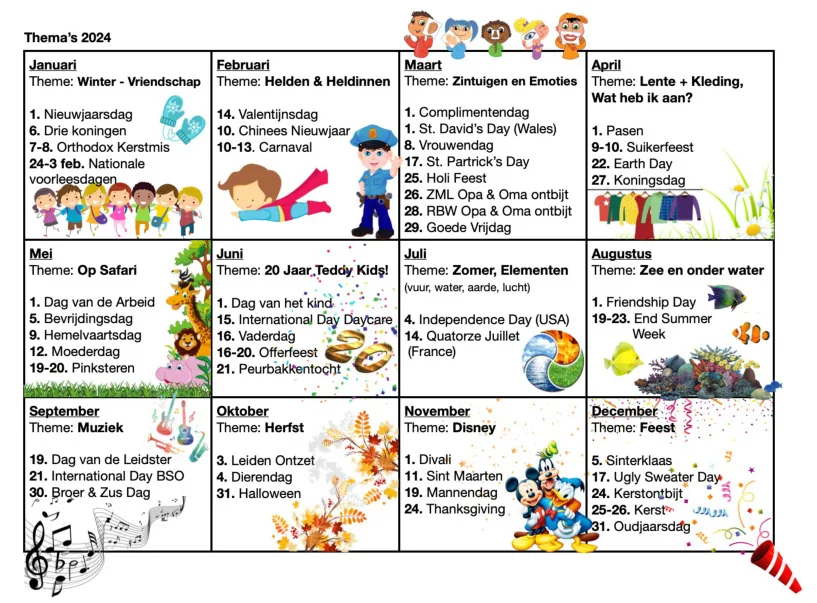
Activity coordinators
We employ multiple activity coordinators for a number of different activities. For the age group 1.5 - 4, we have an educational entertainment programme that consists of numerous expressive elements, such as music, dance, singing, movement, yoga and tennis for children. All our activities are relatable to the children, and appropriate to their worldview. Activities are in Dutch and English.
Dance lessons and Music lessons
Dance and Music Classes
We organize dance and music classes at each location.
Esther is an experienced dance instructor who also teaches ballet at the Leidse Balletschool. Esther has become a staple at Teddy Kids.
Alice is our music teacher. She introduces all children to various musical instruments and different sounds of music.
Toys and play equipment
Playing in groups and playing individually are very important for children’s development. During play time, children learn to explore their curiosities, to try new things, to test and practice their skills. Through play, children learn to overcome obstacles and learn new skills.
At Teddy Kids we watch and listen attentively to the children during their play time, to observe whether they are stimulated enough or whether we can add more invigorating challenges to their day.
Group space
Teddy Kids has divided the group rooms into horizontal groups. The indoor and outdoor space are designed in such a way as to invite play according to the age of the group. We invite play with different types of toys: everyday, special, and outdoor toys.
Everyday toys
In the groups we also have general toys appropriate to that group’s age. The children recognise them and appreciate the familiarity that comes with finding them in the room every day. The general toys are kept in fixed places in cupboards or boxes that the children can access themselves, which stimulates them to choose what they like during free play. General toys may include:
- kitchens (ALL our children’s kitchens were built by our very own carpenter, Joop!)
- garages
- puppet theatres
- crawling toys (which the children can crawl through)
- Dollhouse, doll clothes, beds, accessories
- train track
- marble run
- chalk board
- cupboards with books, plush toys, animal menageries, cars and more!
Special toys
To stimulate the children sufficiently, we rotate toys so that the children remain interested in them and have a new challenge every day. Special toys are taken out of the closet with the child together with the pedagogical staff so the children may have a choice for which toys they want to play with. Special toys may include:
- Magnetic sand
- Large LEGO® blocks
- Various puzzles
- Feel/sensory books
- Dress-up clothes
Outdoor toys and equipment
We have outdoor toys for all age groups. The pedagogical staff and the children choose together what they want to play with at that moment. Outdoor toys may include:
- cars
- bicycles, walking bicycles, training bicycles
- seesaws, spring rocking chairs, etc.
- balls
- watering cans, etc.
Playing outside
At Teddy Kids, we think it’s very important to go outside at least once a day (weather permitting, of course). Every location has an outdoor garden where all children are free to play and move around.
Periods when we don’t go outside:
- When temperature drops to -5 degrees Celsius or below
- When temperature reaches 30 degrees Celsius or higher
- During heavy rain
- Babies never go outside in the case of rain
Field trips
A few times a year, we take children age 2 and up on field trips. Prior to a field trip, every parent needs to provide written permission via a permission form. Field trips can be anywhere from libraries to playgrounds. A minimum of 2 teachers is always present during these field trips.
Special Days
Every year Teddy Kids organises some extra special activities including:
Grandparents Easter Breakfast (2.5 - 4 years old)
In March we host Grandparents Breakfast, where the children ages 2.5 - 4 welcome their grandparents to join in for a lovely Easter breakfast. The children show their grandparents their classrooms and perform dances and other activities together.
Sinterklaas Party
Every year we celebrate the national holiday “Sinterklaas" with all the children at Teddy Kids. The children join in many activities planned throughout the day including dancing with the “Pieten” and enjoying a puppet show. At the end all children receive a present from Sinterklaas that they can take home!
Christmas Lunch
The first Monday of the Christmas break we organise a special lunch. All children may come in their pyjamas and join an early lunch. (Don’t forget to bring a set of clothing for the rest of the day.)
Portrait Day
Once a year, a photographer visits Teddy Kids to photograph all the children. Each year, they receive an individual portrait and a group photo. We have a Teddy Kids staff member who is a professional photographer and visits all locations to take the photos. Therefore, the children have a familiar face at the location.
International Day
Once a year Teddy Kids organises our most important party: International Day! All children, parents, and family are welcome to join the festivities. Everyone brings their national dish to the party. We all dig in and enjoy the different cultures of the world.
Nutrition
Babies’ nutrition
Just as with babies’ schedules, we take instruction from the parents to build your baby’s menu from breastmilk or formula up to solid foods. When the time is right for fruits and vegetables and bread, the babies enjoy organic food provided by a local company from Utrecht, Moekes Maaltijd. The menu for the week is on the information boards next to the group and can also be found in Zaycare.
Toddlers’ nutrition
During lunch time the children eat a warm lunch which is frequently customary in the international community. The food is provided by a local company from Utrecht, Moekes Maaltijd www.moekesmaaltijd.nl. Moekes prepares 100% natural and fresh lunches for children at daycares and schools, providing organic foods from sustainable farming as much as possible. For example, the free-range meats come from Palmensteyn; the fish from Jan van As; the eggs from Maartens Marktkraam; and all the grains from Korenmolen de Zandhaas in Santpoort. The children enjoy a variety of foods with everything from fish, chicken, different types of meats, but also potatoes, rice and pasta. The children also get seasonal fresh vegetables from the local farmer’s markets. The menu for the week is on the information boards next to the group and can also be found in Zaycare.
Special dietary needs
We hold your child’s nutrition to a high standard and we are willing to accommodate special dietary requirements. Teddy Kids makes adaptations for vegetarian, gluten-free, dairy-free, nut-free and halal diets. If your child has another specific dietary need or an allergy, then we ask parents to please provide the appropriate foods.
Thank you
Thank you for choosing Teddy Kids for your child’s care. Teddy Kids is always open to suggestions about your pedagogical approach and the children’s daily activities.
Get in touch with us at info@teddykids.nl or the parents committee of your location. You can reach the parents committee through your location’s head teacher.
More details and all contact information can be found in the appendix in the following pages.
We can’t wait for your amazing Teddy Kids experience to begin!
Appendix
About Teddy Kids
Teddy Kids International Daycare Leiden opened our very first location at Herenstraat in 2004. Now 15 years later, we have grown to family owned and operated organisation with daycares in four different locations and two after school care locations. Spread out over these locations are more than 50 highly qualified permanent teachers of varying nationalities and backgrounds. We pride ourselves on how we have evolved into our signature multicultural atmosphere.
Leiden has a large and diverse international community that is attractive for both work and studies. Places likes the LUMC, University of Leiden and Webster University or the BIO science park, among others, make it an attractive expat hub. It makes Leiden a great place for both Dutch and international communities, and that’s also why we moved here in the 1990s.
When we first moved to the Netherlands, and Leiden in particular, we were impressed by the international orientation of schools and the community, but we felt that there was a big gap for working expats to have their children attend international daycare, as well as a lack of bilingual opportunities for Dutch children. We decided that we could make the transition to Dutch life smoother, while providing a gateway to other cultures for Dutch families. Building on our own experiences as expats, we built a company on the principle that Dutch and international children can learn and grow together.
We still believe that principle lays the foundation for a more globally-aware and culturally-sensitive society, and we do everything in our power to make that happen. That’s what makes us who we are and that what makes Teddy Kids a perfect choice for parents and children who want to broaden their horizons and bridge the divide between cultures and countries.
The Teddy Kids Promise
We’re the international childcare centre of Leiden and we want to offer the best childcare experience we can for your children—and you, the parents! The Teddy Kids Promise is:
#1 Unmatched flexibility with flexible drop-off and pick-up times, booking extra days, voucher or cash back bonus options, no extra fees to cancel a contract, accommodating dietary needs for the children, introducing customs from home, speaking both Dutch and English in the groups, and fostering open communication throughout the Teddy Kids community.
#2 Quality qualified, experienced, caring pedagogical staff. More than half of our teaching staff is permanent staff. That’s remarkable for this industry! In addition, our international team come to us with their respective qualifications, but Teddy Kids goes above and beyond with trainings and continuing education for them.
#3 The best nutrition. We lay the foundation for a healthy start in life, including warm lunches and seasonal, sugar-free snacks.
#4 An international environment. We embrace our many cultures by joining in each other’s celebrations and customs. Our curriculum, activities and staff are all built around a respectful multi-cultural atmosphere to prepare our children to become inspired, empathic citizens of the world.
Don’t forget the cherries on top!
Beyond these commitments, the Teddy Kids package includes—at no additional cost—these awesome services:
- Our own experienced paediatrician who has cared for Teddy Kids little ones since we opened our doors in 2004. She is one of our head teachers and brings her expertise and sets an example for all our staff.
- Our own in-house child development specialist who designs age-appropriate curriculum to develop children’s cognitive, language, motor and social skills.
- Child activity specialists who lead weekly dance lessons, music lessons, yoga lessons, plus drama AND cartoon drawing lessons AND tennis lessons for the after school care programme!
- Additional child development specialists such as speech therapists who observe the groups and provide assessments.
- In-house expert carpenters who design and build fun, safe, original and creative play equipment and furniture for every group. Literally building the Teddy Kids difference, with love, right on our premises!
- The Teddy Community, to welcome and introduce our families, get to know each other, get to know the Leiden area and the Dutch way of life.
We consider these services the standard offer. The way childcare should be.
Contact Information
Directors
Artem Tolmachev 06 14 66 30 33 artem@teddykids.nl
Tess van Overbeeke 06 20 96 64 05 tess@teddykids.nl
Managers / Head Teachers
ZML
Svetlana Bolotina svetlana@teddykids.nl
ZML
Meral Demirbas-Akdeniz 06 39004512 Meral@teddykids.nl
RBW
Jess Otten-Koel 06 139004513 Jess@teddykids.nl
LRZ
Antonella Falcone
RB3& RB5
Pamela Pradenas Farias 06 39 00 45 14 Pamela@teddykids.nl
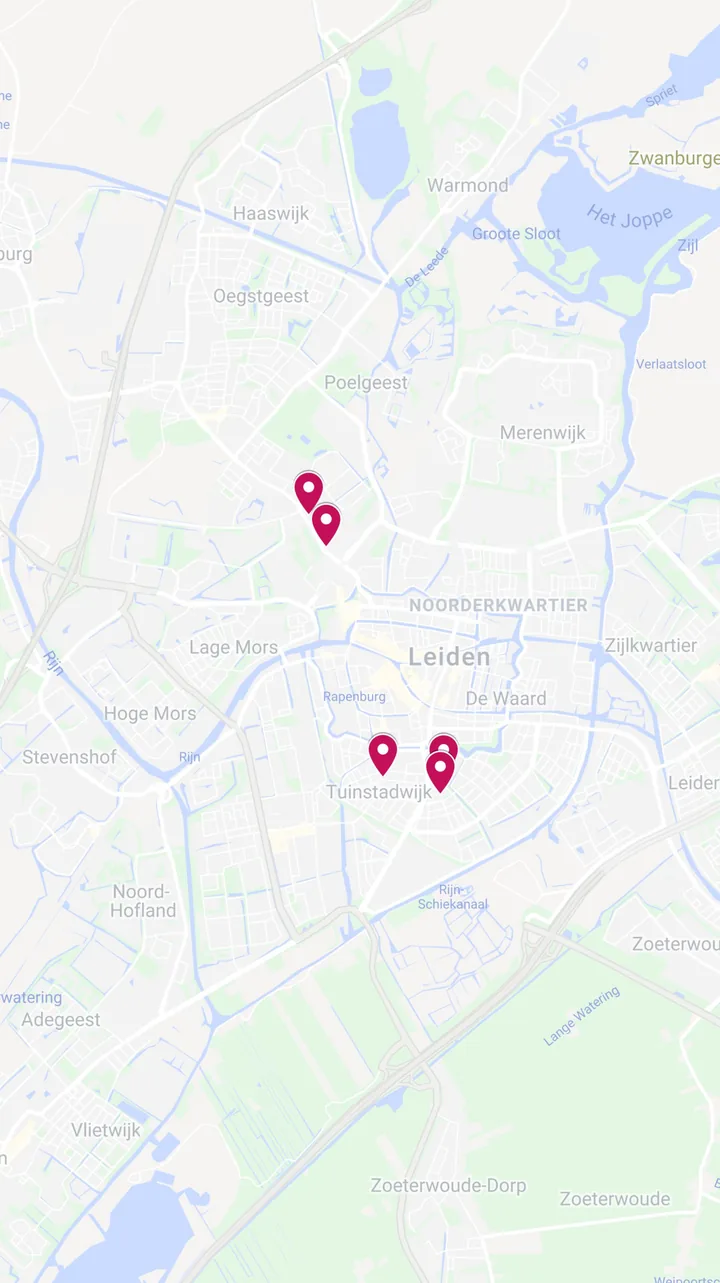
Our Locations
Teddy Kids Daycare RBW
Rijnsburgerweg 35 2334BE, Leiden
LRK 467490533
Teddy Kids After School Care RB3 en RB5
Rijnsburgerweg 3 2334BA, Leiden
LRK 304133553
Teddy Kids After School Care LRZ
Lorentzkade 15a 2313GB, Leiden
LRK 237220672
Teddy Kids Daycare ZML
Zeemanlaan 22a 2313SZ, Leiden
LRK 205183438
Find us online: teddykids.nl | help.teddykids.nl | Instagram: @teddykids.nl | Facebook: /
Child’s Belongings Checklist
Friendly reminder: Label your belongings with your child’s name and a phone number, in case anything goes missing.
Parents Committee
| What to bring | Age 0 - 1.5 | Age 1.5 - 4 | Age 4 - 8 |
|---|---|---|---|
| Extra underwear | ✔ | ✔ | |
| Extra trousers / pants | ✔ | ✔ | ✔ |
| Extra shirt | ✔ | ✔ | ✔ |
| Extra romper / onesie | ✔ | ✔ | |
| Extra socks | ✔ | ✔ | ✔ |
| Sleeping bag | ✔ | ✔ | |
| Inside shoes | ✔ | ✔ | ✔ |
| Pacifier | ✔ | ✔ | |
| Bottle | ✔ | ||
| Notebook | ✔ | ||
| In winter: Warm clothing | ✔ | ✔ | ✔ |
| In summer: Swim suits | ✔ | ✔ | ✔ |
The Teddy Kids Parents Committee (Oudercommissie or OC) comprises a number of parents from each location, active volunteers who look after and represent the interests of all parents of the children at our daycare and after school care.
Main responsibilities of the Parents Committee
- 1)Monitoring and promoting the quality of the childcare by providing solicited and unsolicited advice to Teddy Kids.
- 2)Improving communication between parents and Teddy Kids.
Examples of topics for discussion between the Parents Committee and Teddy Kids:
- Changing the children’s groups (adjust ages, group size, etc.)
- Nutrition policy changes
- Planning policy, Price changes
- Opening hours
- Pedagogical approach
- Dissatisfied with employees who do not work according to pedagogical policy
- Communication from Teddy Kids to parents
Committee Members
Members comprising the parents committee should be good reflection of the parents of the location they represent.
- Committee consists of at least 3 members and at most 4 members (exception: Rijnsburgerweg 35 location, with 7 members)
- At minimum consists of 3 roles: chair, secretary and treasurer
- A maximum of only one parent per household may sit on the committee
- No parents working for Teddy Kids may participate in the parents committee
Some tasks and responsibilities
Your role is to keep parents informed of activities, highlights, motivate their participation, make sure they are informed, and communicate parents’ ideas and needs to Teddy Kids.
Other expectations:
- Organise present for Teacher Day (with budget provided by Teddy Kids)
- Encourage open communication that ultimately leads to a better experience for the children
- Attend committee meetings at least 4 times a year
Interested in volunteering?
Great! Please send a message to the head teacher of your location to join the team.