A Real Daycare Day, Hour by Hour
You hand over your child and hear "good day!" at pickup. Here's everything that happens in between.
For most parents, daycare is a black box: you drop off a sleepy child in the morning and collect a different, tired-but-happy one in the afternoon, with almost no idea what filled the hours between. This guide opens the box — the real rhythm of a Teddy Kids day, block by block, and the small everyday magic your child can't yet put into words.
Open the box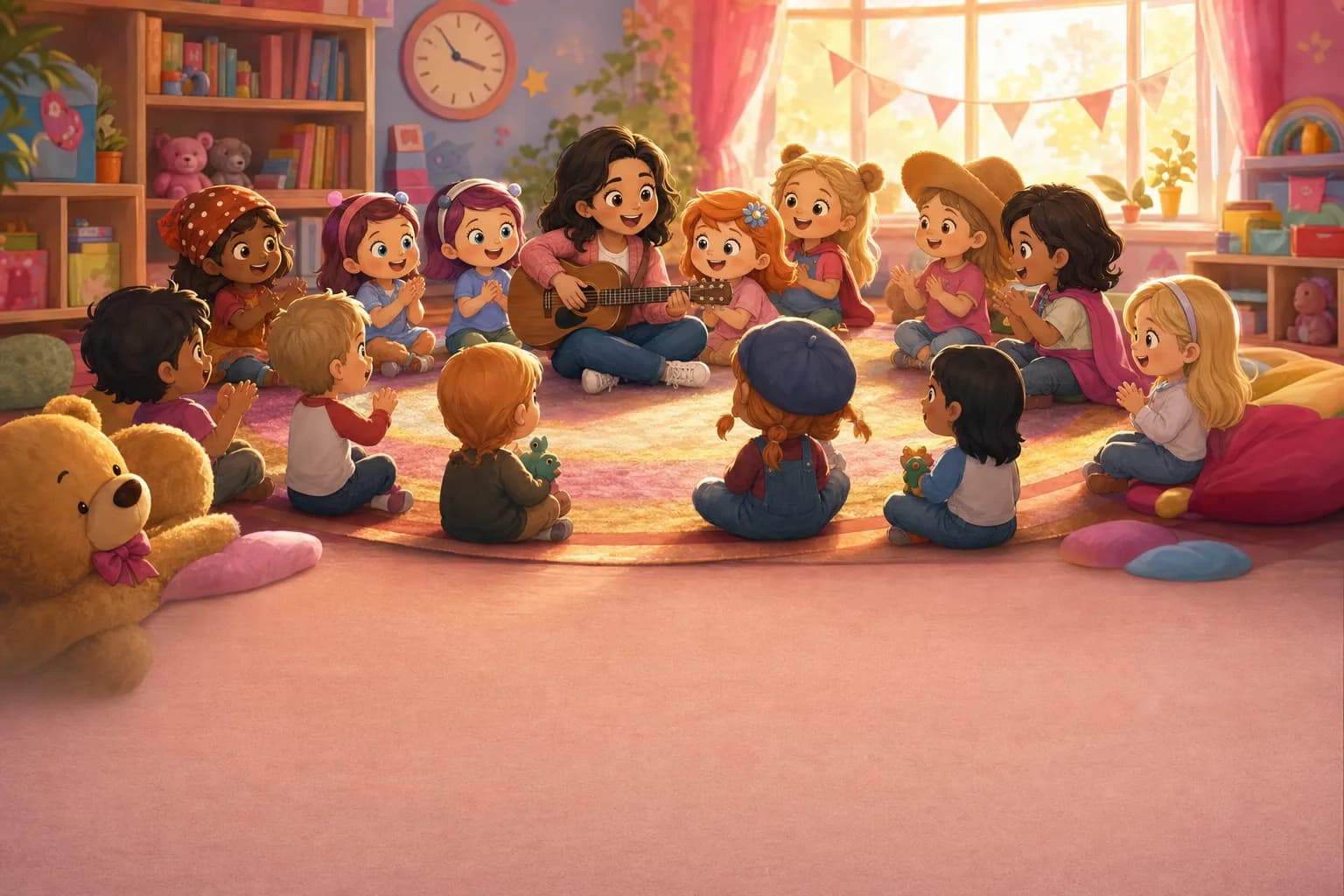
Last updated: 23 July 2026
What's really inside the black box
A daycare day isn't random. Under the play and the noise there's a steady, predictable rhythm — the same anchor points every day, at roughly the same times — because young children feel safest when they know what comes next. Arrival, a shared start, play, food, sleep, more play, home.
This guide walks you through that rhythm the way your child lives it. We've kept two versions in mind: the baby room, where the day still bends around each little one's own sleeping and eating clock, and the toddler room, where the day settles into a shared flow. Wherever a real Teddy Kids detail belongs — an exact time, today's lunch, the song we always sing — we've written it plainly and marked it for review, because your own group's mentor is the person who knows your child's day best.
The baby room, hour by hour
In the baby room, the clock bends to the child, not the other way around. A young baby sleeps and drinks on their own rhythm, and we follow the schedule you bring from home. The times below are the room's gentle framework — the shared moments the group drifts toward — not a rule your baby has to fit into.
| Time | Roughly | What's happening |
|---|---|---|
| 7:30–9:00 | Arrival window | Drop-off and a calm handover. You tell us how the night went, when your baby last drank and slept; we write it down so the day continues yours. |
| 9:00 | Short & sweet | A little morning moment together — a song, a hello to each baby by name — before the group settles into play and first naps. |
| Morning | On demand | Bottles, first naps, tummy time and one-on-one cuddles. Everything on your baby's own clock. |
| 11:30 | ~30 min | A shared lunch moment for the older babies who eat solids, at their own pace and mess allowed. |
| Afternoon | On demand | The big afternoon sleep for most, then more bottles, floor play and exploring. |
| From 16:30 | Pickup window | Pickup and handover: what your baby ate, slept and discovered today. |
- Keep sending your home rhythm — feeds and sleep times — so we can mirror it
- Label bottles, dummies and comfort cloths; the small familiar things matter most
- A short, confident goodbye helps your baby settle faster than a long one
The toddler room, hour by hour
By toddler age, the day has a clear shape the children can lean on. They start to know it by heart — "first fruit, then outside" — and that knowing is what makes them feel calm and capable. Here is a typical full day, morning to pickup.
| Time | Roughly | What's happening |
|---|---|---|
| 7:30–9:00 | Arrival window | Free play as the group fills up. Children arrive, hang up their own coat and bag, and find their way into play. |
| 9:15 | ~15 min | Circle time: the day officially begins. We sing, say good morning, and name who is here and who is home today. |
| 9:30 | ~30 min | Fruit and a drink together at the table, then a wash of hands and faces. |
| 10:00 | ~60 min | Outside or an activity: the garden, a walk, or a craft, water or building session. |
| 11:30 | ~45 min | Lunch together — the big social meal of the day, everyone at the table. |
| 12:15 | ~2 hrs | Nap and rest: a quiet, darkened room. Non-sleepers rest and then play calmly. |
| 14:30 | ~30 min | Waking up gently, nappies and toilet, then a snack and a drink. |
| 15:00 | Open | Afternoon play, often back outside, until the first parents arrive. |
| From 16:30 | Pickup window | Pickup and handover, with the highlights of your child's day. |
- Arriving before circle time helps your child slot into the day with the group
- Send clothes that can get paint, sand and mud on them — a busy day shows
- The nap block is protected: try to plan pickups around it, not through it
The day, block by block
Each part of the day is its own little world, with its own purpose. Here's what each block looks like from the inside — and why we do it that way.
Arrival & the goodbye
The handover windowThe arrival window isn't a deadline — it's a soft window in which children trickle in and the room warms up. A good goodbye is short and sure: a hug, a wave at the window, and gone. It can feel harsh, but a lingering goodbye tells a child there's something to worry about. Nine times out of ten, the tears stop within a minute of the door closing — and we'll happily text or tell you so.
Circle time
The day beginsA short sit-together that marks the switch from arriving to being here. We sing the same opening songs each day, say good morning to each child by name, and talk about the day, the weather, and who's here and who's poorly at home. It's tiny, but it does big work: it builds belonging, language and the comfort of the familiar.
Outdoor play
Rain or shineWe go outside every day the weather even slightly allows — there's no such thing as bad weather, only the wrong coat. Outside is where the big learning hides: balance, risk, the feel of cold air and wet grass, running until you're properly tired. On rainy days we suit up in rainwear and boots and go anyway; a splashed puddle is a lesson too.
Lunch
The social mealLunch is the loudest, happiest moment of the day: the whole group at the table together. It's about far more than food — it's passing the basket, waiting your turn, trying "just a little taste" of something new because the child opposite is eating it. Children serve themselves what they can, spills and all, because doing-it-myself is half the point.
Nap & rest
The quiet hoursAfter lunch the room changes character: curtains drawn, voices low, each child in their own familiar spot with their own comfort thing from home. We settle children the way they're used to — some drop off in seconds, some need a hand on the back. Children who no longer nap rest quietly first, then play calmly, so the sleepers get the deep, unbroken sleep a busy little body needs.
The afternoon
Winding throughWaking up is its own gentle ritual — no child is rushed out of sleep. Then a snack, fresh nappies or a toilet trip, and the afternoon opens up: often back outside, or a slower activity while the group thins out. The pace softens on purpose, so children are calm and gathered by the time you appear at the door.
Pickup & handover
Bringing the day homeAt pickup we hand you the day: how they ate and slept, the funny thing they said, the first time they climbed that step alone. Some of it comes in person, some in a note or app so nothing gets lost in the doorway rush. And if your child melts down the second they see you — that's the biggest compliment there is. It means they held it together all day and finally feel safe enough to let go.
The thread through every block
- Predictable order first, exact clock-time second — sequence is the security
- Every child has a fixed mentor who knows their signals and holds their story
- Transitions are announced and sung, never sprung — children are told what's next
What your child can't tell you yet
A two-year-old asked "what did you do today?" will almost always answer "nothing" or "played" — not because nothing happened, but because they don't yet have the words for it, and because to them it wasn't news, it was just their day. Here's some of the small magic that goes home invisibly in their pockets.
The moments you never see
- The first time they shared a toy without being asked — and looked around to check someone noticed
- A whole conversation in the other language, sung more than spoken
- Comforting a crying friend by bringing them their own comfort cloth
- Ten quiet minutes just watching rain slide down the window, together
- The private victory of pulling on one welly boot entirely alone
How to unlock the day at home
- Skip "what did you do?" — ask "who did you play with?" or "was it a garden day?"
- Offer a choice: "did you sing the goodmorning song, or the goodbye one?"
- Wait until bath or bedtime — the day often spills out sideways when they're relaxed
- Read the mentor's note first, then ask about one specific thing from it
- Let "nothing" be a fine answer — a calm, ordinary day is exactly what you want
Two languages, one rhythm
Teddy Kids is bilingual, so the day itself is bilingual — not as lessons, but woven through every moment. The same song might start in English and finish in Dutch; a caregiver greets one child in one language and the next in another. Children soak it up through the rhythm and repetition of the day, not through drills. Here's the day in both tongues.
Greetings & goodbyes
- "Good morning!" / "Goedemorgen!" — sung to each child at circle time
- "See you later!" / "Tot straks!" — the standard goodbye at the door
- "Wave at the window!" / "Zwaai voor het raam!"
Songs we sing
- A goodmorning song naming each child who's here today
- A tidy-up song that signals "we're switching activities"
- A handwashing rhyme before every meal
- A weather song — sun, rain, wind — to open circle time
Everyday phrases
- "Time to eat!" / "Eten!" at the lunch table
- "Coats on!" / "Jassen aan!" before going outside
- "Sleep tight" / "Slaap lekker" at the nap-room door
- "Your turn" / "Jouw beurt" — sharing and taking turns
Don't worry if your child mixes the two languages at home for a while, or leans hard on one — that's a completely normal, healthy stage of growing up bilingual, not a sign of confusion.
The questions parents actually ask
The things you wonder about on the drive home, gathered in one place.
My child cried at drop-off — were they upset all day?
Almost never. Drop-off tears are about the goodbye, not the day, and they usually pass within a minute or two of you leaving. If you'd like the reassurance, just ask us to message you once your child has settled — we're glad to.
What if my child won't nap at daycare?
Sleeping in a busy new place takes practice, and some children need a few weeks to find it. We settle them the way they're used to at home as far as we can, and we never force sleep — a child who truly won't sleep rests quietly instead. We'll always tell you honestly how the naps are going.
Does every location run exactly the same day?
The rhythm and the anchor points are the same across Teddy Kids — arrival, circle, outside, lunch, sleep, afternoon, pickup — but the exact times, the garden, and small routines can differ a little from location to location and between the baby and toddler groups. Your own group's mentor is always the best source for your child's precise day.
How can staff give my child enough attention in a group?
Group life is part of the value, not a compromise: children learn to share, wait, and belong. Within that, your child has a fixed mentor who knows their signals, and the whole day is built to create one-on-one moments — a nappy change, a lap at story time, being settled to sleep. The attention is woven through the routine rather than added on top.
My child is exhausted and cranky after daycare. Is that bad?
It's the sign of a full, stimulating day among other children — a lot of input for a small brain to process. The after-daycare meltdown is often a release of a whole day of holding it together. A calm, low-key evening with an early night usually sets things right.
Can I call during the day to check in?
Of course — especially in the settling-in weeks, a quick check-in is completely normal and we'd rather you asked than worried. The team can tell you in a moment how your child is doing right now.
Read a little further
Trusted places to learn more about young children's rhythm, development and daycare in the Netherlands.
- Opvoeden.nl — everyday parenting and daycare information (Dutch)
- NJi — Netherlands Youth Institute, on child development and childcare
- GGD — your regional Youth Health Service (consultatiebureau)
- Your child's own mentor at Teddy Kids — the best source for their day
About this guide
This guide describes the general rhythm of a day at Teddy Kids to help you picture what your child experiences; exact times, meals and routines vary by location and age group, and your own group's mentor is always the authority on your child's day. It's for reassurance and understanding, not a substitute for professional advice — for questions about your child's development, sleep, eating or health, please turn to your consultatiebureau (GGD/JGZ) or huisarts.
Teddy Kids is here for you
As your twins grow, we grow with you — with warm, bilingual childcare in Leiden.