Starting school at 4: from daycare to basisschool (or international school)
The jump that surprises almost every international family — and how much time and choice you really have.
In the Netherlands your child can start primary school (basisschool) at 4 — years earlier than in most countries. It feels sudden, but you have real choices and enough time to make them calmly. This guide walks you through how it works, the transition itself, and both the Dutch and international routes.
Start reading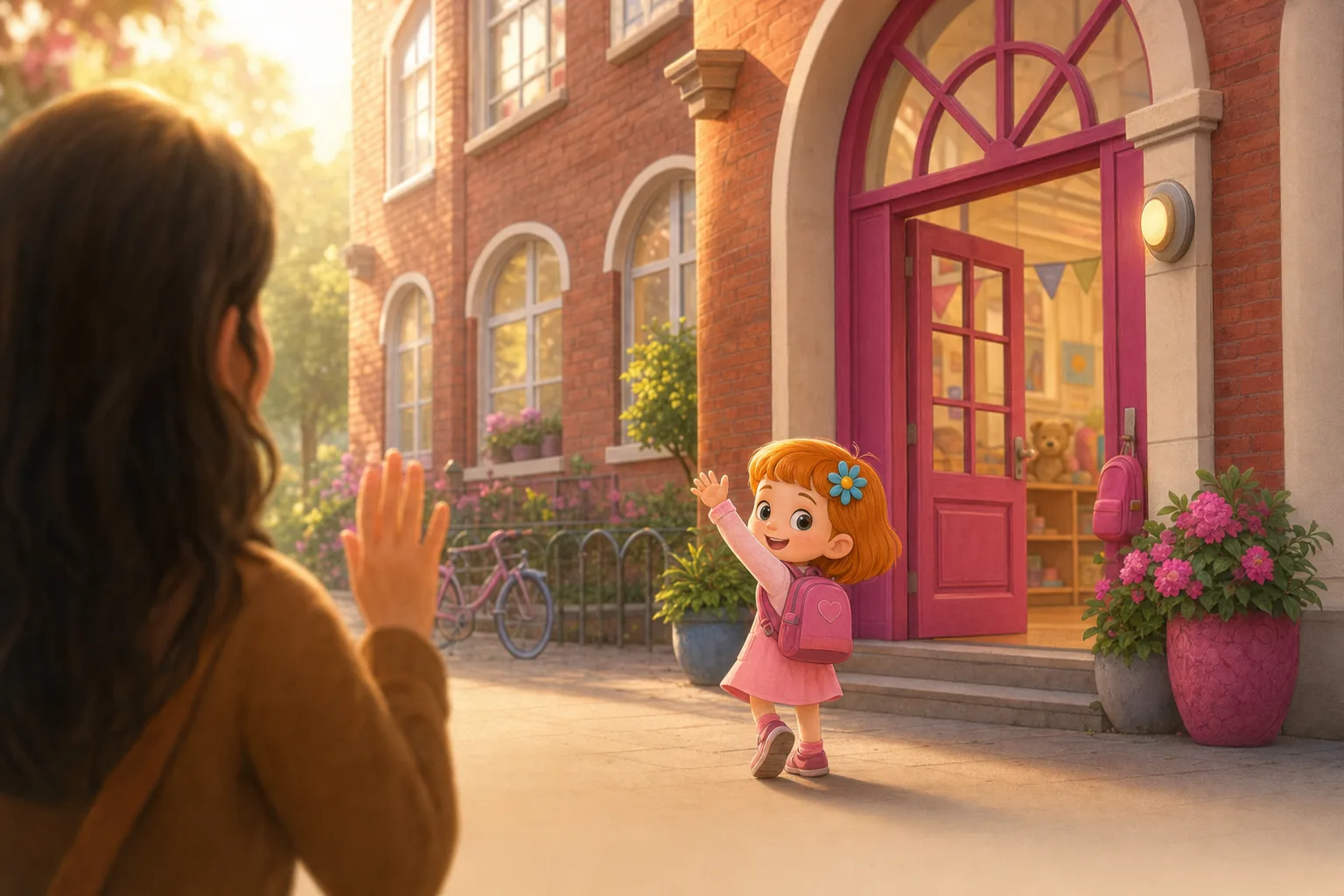
Last updated: 23 July 2026
Your toddler starts school at 4 — breathe, you have time
For many families moving to the Netherlands, this is the plot twist nobody warned them about: your child can start basisschool (primary school) the day they turn 4. Not preschool — actual school, with a class, a teacher and a place in group 1. After the gentle world of daycare, it can feel like a big leap arriving very early.
Here's the reassuring part. Starting at 4 is allowed, but not required. Compulsory education (leerplicht) only begins the month after your child turns 5. That gap — roughly a year — is yours. You get to choose the school, visit calmly, and let your child settle in at their own pace. Dads, mums, partners: this guide is for whoever is doing the school hunt.
We'll cover how the Dutch system works, what actually changes for your child, the international schools near Leiden, and where TISA — our own international school — fits in. No pressure, no jargon left unexplained.
How Dutch basisschool actually works
Dutch primary school runs from group 1 to group 8, roughly ages 4 to 12. Your child slips into group 1 whenever they turn 4 during the year — so classes fill up gradually rather than all starting on one September morning. Around Leiden, enrolment is refreshingly local: you approach the school directly.
The good news (timing & choice)
- Age 4 = allowed to start; the month after age 5 = legally required (leerplicht)
- Leiden has no citywide lottery — you register directly with the school you want
- Registration can open from your child's 3rd birthday, so there's time to look around
- Your child may attend up to 5 wendagen (settling-in days) between 3y10m and turning 4
Registering (aanmelden) step by step
- Shortlist schools and book orientation visits (many hold open mornings)
- Register (aanmelden) directly with your chosen school — in Leiden, not via the gemeente
- Know that aanmelden ≠ toelaten: schools weigh siblings, catchment and waiting lists
- Every gemeente sets its own rules — if you're outside Leiden, check your own municipality's page
The kinds of school you'll meet
Two things confuse newcomers most: the openbaar/bijzonder split, and the pedagogical names on the door. Here's the short version. Crucially, 'bijzonder' does not mean private — almost all Dutch primary schools, whatever their identity or method, are fully government-funded.
Governance & identity
- Openbaar (public): neutral, no religious or ideological identity, run by the municipality or a public foundation
- Bijzonder (special): founded on a religious identity (e.g. Catholic, Protestant, Islamic) or a teaching philosophy — but still fully state-funded, not private
- The label describes who governs and what values shape the school, not the price
Teaching philosophies (onderwijsconcepten)
- Montessori: child-led, self-chosen work with special materials, mixed-age groups
- Dalton: freedom within structure — planning, independence and cooperation
- Jenaplan: family-style groups, rhythm of conversation, play, work and celebration
- Vrije School (Steiner/Waldorf): seasonal rhythm, arts and imagination woven through learning
Each philosophy is a recognised schoolsoort with its own method, not an add-on. The best way to feel the difference is simply to visit two or three and notice which room your child relaxes in.
The transition itself, step by step
The leap from daycare to school is real, but it's designed to be gentle. Dutch schools ease children in with visits and trial days, and the after-school gap is covered by BSO. Here's the arc most families walk.
Step 1 — Orientation visits
From age 3
Book open mornings at a few schools and go together. Watch how the group 1 room feels, how staff speak to children, whether there's outdoor play. This is also when you register (aanmelden) at the school you like most.
Step 2 — Wendagen (settling-in days)
3y10m until turning 4
In the weeks before their 4th birthday, your child may join the class for up to five trial days. These short visits let them meet the teacher, find the coat hook with their name on it, and picture themselves there before the real start.
Step 3 — What changes for your child
The first weeks
Expect bigger groups than daycare, fixed start and finish times, a more structured day, and lots of learning through play in group 1 and 2. It's normal for a child to be extra tired at first — school takes energy. Short days and early nights help.
Step 4 — BSO for after school
From day one, if you need it
School days are shorter than a daycare day, so many working families use BSO (buitenschoolse opvang) for the after-school hours and holidays. BSO is regulated childcare, so it runs through the kinderopvangtoeslag system — unlike school itself, which is free at public and bijzonder schools.
- Visits and wendagen mean the first real day is rarely a cold start
- A predictable rhythm at home softens the tiredness of the first weeks
- BSO bridges the gap between short school days and working hours
- Group 1 and 2 are still play-based — this is not sitting-at-desks school yet
International schools near Leiden
If you'd rather keep your child in an English-language or international curriculum, the Leiden–Den Haag region has real choice — from lower-cost, partly state-funded options to fully private schools. Below are verified schools with a one-line profile each. Fees change often, so treat the fee character as a rough guide and always confirm current tuition with the school. TISA, our own international school in Leiden, has its own section just below.
International School Leiden (ISL)
Leiden · lower-cost, non-profitAges 4–11. An international, theme-based primary programme (IPC referenced), run under a Leiden educational foundation (SCOL). Non-profit and municipality-linked, so notably more affordable than fully private international schools.
Elckerlyc International School
Leiderdorp · partly state-fundedAges 4–11, just outside Leiden. IEYC early years and IPC primary with the British National Curriculum for English and maths, and Dutch woven through daily. A DIPS member — partly government-funded, so fees stay lower than fully private schools.
International School Delft (ISD)
Delft · privateAges 4–11 (primary, PYP 1–7). The IB Primary Years Programme taught in English, with Dutch as a host-language subject. A private international school a short train ride from Leiden.
American School of The Hague (ASH)
Wassenaar · private, high-feeAges 3–18 on one campus. An American curriculum with Advanced Placement and the IB Diploma in the high school. A large, fully private international school with correspondingly high fees.
The British School in the Netherlands (BSN)
The Hague area · private, high-feeAges 3–18 across four campuses. The British National Curriculum with GCSEs, and a Sixth Form choice of A-Levels, the IB Diploma, IBCP or BTEC. Fully private, high-fee.
European School The Hague (ESH)
The Hague · state-subsidisedAges 4–18. The European Schools curriculum with five language sections (Dutch, English, French, German, Spanish), leading to the European Baccalaureate. An accredited European School, partly financed by the Dutch state — subsidised rather than purely private.
HSV International Primary School
The Hague · verify details with the schoolAges 4–11 across several locations in The Hague, plus an international pre-school for ages 3–4. The International Primary Curriculum with English and maths per England's National Curriculum and EAL support. A long-established community school; details and fees vary by location, so confirm directly with the school.
A note on cost & funding
- Dutch public and bijzonder basisscholen are free — you pay only a small voluntary parental contribution
- International schools charge tuition; partly state-funded ones (ISL, Elckerlyc, ESH) sit well below the fully private schools
- Always confirm the current fee, age range and available places with the school itself before deciding
TISA: our own international school in Leiden
Let's be transparent: TISA (Theodore International Startup Academy) is Teddy Kids' own international school, in Leiden. We mention it here not to talk down the schools above — they're genuinely good options — but because for Teddy children it can be the most natural next step. The bilingual English/Dutch foundation your child builds at Teddy Kids daycare flows straight into TISA's pre-school and its IB Primary Years Programme, on one connected pathway in the same city.
Why it can be the natural continuation
- One connected pathway: Teddy Kids daycare (0–4) into TISA pre-school (3+) and Primary (from 5)
- An authorised IB World School offering the Primary Years Programme, with bilingual English/Dutch instruction and daily Dutch
- The same warm, outdoor-play, mentor-led culture your child already knows at Teddy Kids
- Children choose a STEAM or a Creative Arts & Design pathway, with an entrepreneurial thread running through
What to know (honestly)
- TISA Primary is a private, tuition-fee school — this is separate from Teddy Kids daycare, which runs through kinderopvangtoeslag
- We won't quote a figure here because fees change; see the current fees on the TISA site
- TISA is growing: primary is running now, with middle and diploma stages planned in later years
- It's one option among several — the right school is the one that fits your child and family, ours included or not
Dutch route or international route?
There's no wrong answer here — only trade-offs. Weigh them against your family's real plans: how long you'll stay, what languages you want your child to hold, your budget, and where siblings already are. Here's an honest look at both.
The Dutch route (basisschool)
- Language: your child becomes fluent in Dutch — a huge asset if you stay, and easier friendships in the neighbourhood
- Cost: free, apart from a small voluntary parental contribution
- Mobility: excellent inside NL, but a Dutch-only curriculum can complicate a move abroad
- Siblings & logistics: local school, local friends, walkable — daily life gets simpler
- Best if: you're planning to stay a while and want your child rooted in Dutch life
The international route
- Language: English-medium learning and an internationally portable curriculum (IB, IPC, British, American, European)
- Cost: tuition fees — from lower at partly state-funded schools to high at fully private ones
- Mobility: designed for globally mobile families; a smoother handover if you move countries
- Siblings & logistics: schools cluster around The Hague, so commutes can be longer from Leiden (TISA and ISL are the local exceptions)
- Best if: your stay is uncertain, or you want your child to continue in an international system
You don't have to decide forever on day one. Children switch routes more often than you'd think — the next section covers how that works.
Frequently asked questions
What if the school we want has a waiting list?
It happens, especially at popular schools. Register early — you can do so from your child's 3rd birthday — and put your name down at a second choice too. Remember that aanmelden (registering) doesn't guarantee a place; each school weighs siblings, catchment and its own waiting list. Ask the school directly where you stand.
Can we switch routes later — Dutch to international, or the other way?
Yes. Families move between the Dutch and international systems more often than you'd expect, especially as plans to stay or leave firm up. The younger the child, the smoother the switch, because the early years are play-based everywhere. If a move is on the horizon, tell both the old and new school so they can help your child bridge.
What about after-school care (BSO)?
School days are shorter than daycare days, so most working families arrange BSO for the hours after school and during holidays. BSO is regulated childcare, so it qualifies for kinderopvangtoeslag, and many schools work with a BSO partner on or near the site. Arrange it early — the good ones fill up.
My child speaks no Dutch yet — is a Dutch school a mistake?
Not at all. At 4 and 5, children pick up a new language remarkably fast through play, and group 1 and 2 are built around exactly that. Many Leiden schools have experience with international families. If you'd rather your child learn in English, an international school is the alternative. Either way, if you're ever worried about your child's speech or language development in any language, the consultatiebureau or a logopedist (speech therapist) is the right place to check — not us.
Is there a bilingual Dutch public school (Dutch + English)?
Bilingual primary education (tweetalig primair onderwijs, TPO) began as a national pilot and, from school year 2026–27, any Dutch primary school is allowed to offer it. We couldn't verify a TPO school in Leiden itself as we wrote this, so treat it as a 'watch this space' rather than a confirmed local option — ask individual schools whether they're starting a bilingual stream.
Useful links
Official sources for the Dutch rules, plus the schools mentioned above. School details change — always confirm current information on the school's own site.
- Rijksoverheid — when may my child start basisschool?
- Rijksoverheid — compulsory education (leerplicht)
- Gemeente Leiden — choosing a school (schoolkeuze)
- Scholen op de kaart — compare schools
- PPO Regio Leiden — schools in the region
- TISA — Teddy Kids' own international school
- International School Leiden (ISL)
- Elckerlyc International School (Leiderdorp)
- International School Delft (ISD)
- American School of The Hague (ASH)
- The British School in the Netherlands (BSN)
- European School The Hague (ESH)
- HSV International Primary School (The Hague)
About this guide
This guide is for general information and reflects the Dutch system and Leiden-region schools as we understood them when it was written. School details — age ranges, curricula, fees, admission rules and waiting lists — change often, and enrolment rules are set per gemeente, so always verify current information directly with each school and your own municipality. In the interest of transparency: TISA is Teddy Kids' own international school, and we say so plainly — the other schools listed here are included on their own merits, not to steer you toward ours. Questions about your child's development belong with the consultatiebureau or a specialist, not this guide.
Teddy Kids is here for you
As your twins grow, we grow with you — with warm, bilingual childcare in Leiden.